
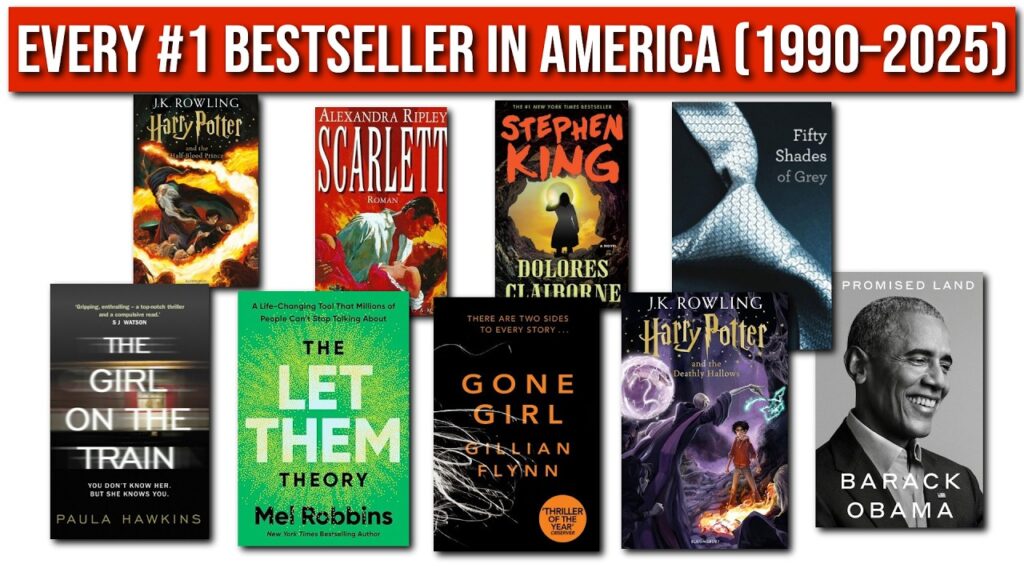
For more than three decades, the American book market has been shaped by a handful of recurring names — John Grisham, Dan Brown, J.K. Rowling, Colleen Hoover — and by the occasional phenomenon that broke through into popular culture. Here, year by year, are the best-selling books in the United States from 1990 to 2025.
The 1990s: The Grisham Decade
1990 — The Plains of Passage, by Jean M. Auel (Crown). The fourth installment in the prehistoric Earth’s Children saga.
1991 — Scarlett, by Alexandra Ripley (Warner Books). The authorized sequel to Gone with the Wind.
1992 — Dolores Claiborne, by Stephen King (Viking).
1993 — The Bridges of Madison County, by Robert James Waller (Warner Books). A cultural phenomenon later adapted for the screen with Clint Eastwood and Meryl Streep.
1994 — The Chamber, by John Grisham (Doubleday). The beginning of an unprecedented run.
1995 — The Rainmaker, by John Grisham (Doubleday).
1996 — The Runaway Jury, by John Grisham (Doubleday).
1997 — The Partner, by John Grisham (Doubleday).
1998 — The Street Lawyer, by John Grisham (Doubleday).
1999 — The Testament, by John Grisham (Doubleday). Six consecutive years at the top — a record.
The 2000s: Dan Brown and the Blockbusters
2000 — The Brethren, by John Grisham (Doubleday).
2001 — Desecration, by Tim LaHaye and Jerry B. Jenkins (Tyndale House). The ninth installment in the Christian apocalyptic Left Behind series.
2002 — The Summons, by John Grisham (Doubleday).
2003 — The Da Vinci Code, by Dan Brown (Doubleday). The novel that would dominate three consecutive years.
2004 — The Da Vinci Code, by Dan Brown (Doubleday).
2005 — Harry Potter and the Half-Blood Prince, by J.K. Rowling (Scholastic). The sixth book shattered every launch record.
2006 — For One More Day, by Mitch Albom (Hyperion).
2007 — Harry Potter and the Deathly Hallows, by J.K. Rowling (Scholastic). The series finale, with an unprecedented global launch.
2008 — The Tale of Despereaux, by Kate DiCamillo (Candlewick). Boosted by its animated film adaptation.
2009 — The Lost Symbol, by Dan Brown (Doubleday). One million copies sold on the first day.
The 2010s: Phenomena and Adaptations
2010 — The Girl Who Kicked the Hornet’s Nest, by Stieg Larsson (Knopf). The posthumous conclusion to the Millennium trilogy.
2011 — The Help, by Kathryn Stockett (Berkley). Lifted by its film adaptation.
2012 — Fifty Shades of Grey, by E.L. James (Vintage). The erotic phenomenon of the decade.
2013 — Inferno, by Dan Brown (Doubleday). Robert Langdon’s third trip to the top of the charts.
2014 — Gone Girl, by Gillian Flynn (Crown). Carried by David Fincher’s film.
2015 — Go Set a Watchman, by Harper Lee (HarperCollins). The controversial companion to To Kill a Mockingbird, published 55 years after the original.
2016 — The Girl on the Train, by Paula Hawkins (Riverhead).
2017 — Origin, by Dan Brown (Doubleday).
2018 — Becoming, by Michelle Obama (Crown). The fastest-selling presidential memoir in American history.
2019 — Where the Crawdads Sing, by Delia Owens (Putnam). A debut novel turned word-of-mouth sensation.
The 2020s: The Power of BookTok
2020 — A Promised Land, by Barack Obama (Crown). Released in November, with record-breaking sales within weeks.
2021 — A Promised Land, by Barack Obama (Crown). The memoir continued its run at the top.
2022 — It Ends with Us, by Colleen Hoover (Atria Books). The book became a global phenomenon thanks to TikTok, five years after its original release.
2023 — It Ends with Us, by Colleen Hoover (Atria Books). A second consecutive year at the top.
2024 — The Women, by Kristin Hannah (St. Martin’s Press). A novel about combat nurses in the Vietnam War.
2025 — The Let Them Theory, by Mel Robbins (Hay House). A self-help guide that dethroned fiction.
A Few Observations Across 35 Years
Several trends emerge from this overview. John Grisham held the number one spot six years in a row between 1994 and 1999 — a feat no one has matched since. Dan Brown claimed the top four separate times (2003, 2004, 2009, 2013, 2017), always with his Robert Langdon character. J.K. Rowling dominated the Harry Potter years, even though Publishers Weekly excluded the series from its adult fiction lists.
The 2010s marked the rise of film adaptations as a sales driver (The Help, Gone Girl, The Girl on the Train), while the 2020s saw the emergence of BookTok: Colleen Hoover watched her 2016 novel It Ends with Us become the country’s best-selling book five years later, powered entirely by the TikTok community.
Finally, political memoirs hold a distinctive place: Michelle Obama in 2018, Barack Obama in 2020–2021. No other nonfiction genre reaches those numbers — with the notable exception of Mel Robbins’s The Let Them Theory, which topped 2025 and confirmed America’s enduring appetite for self-help.
Leave a Reply