News

Ereader news from all over the world!

  • Which e-reader screen size to choose?

    e-readers with different screen size

    Among the different ereaders available, you may have noticed that there are models of different sizes. It is the size of the screen that changes from one e-reader to another and we will see how to choose well.

    Different sizes of e-readers (comparison)

    First of all, here are the different sizes of e-readers that we can find nowadays :

    • 6-inch screen
    • 6.8 inch screen
    • 7-inch screen
    • 7.8 inch screen
    • 8-inch screen
    • 9.6 inch and above screen
    • 10.3 inch screen

    This ereader comparison chart will help you to better see the differences between the various diagonals of the e-readers on the market :

    e-readers  screen size chart comparison

    Image : Comparison chart of the main diagonals of e-reader screens (with electronic ink)

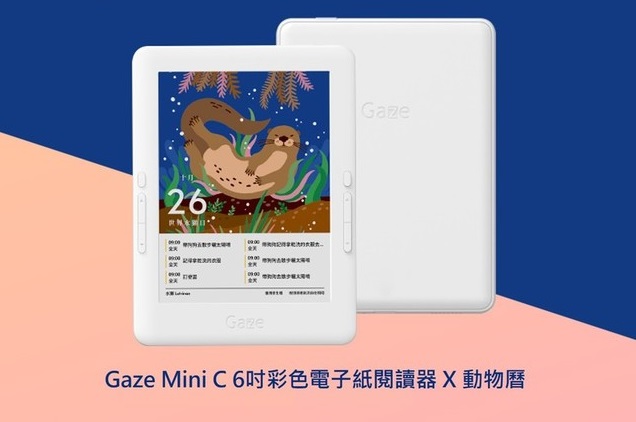
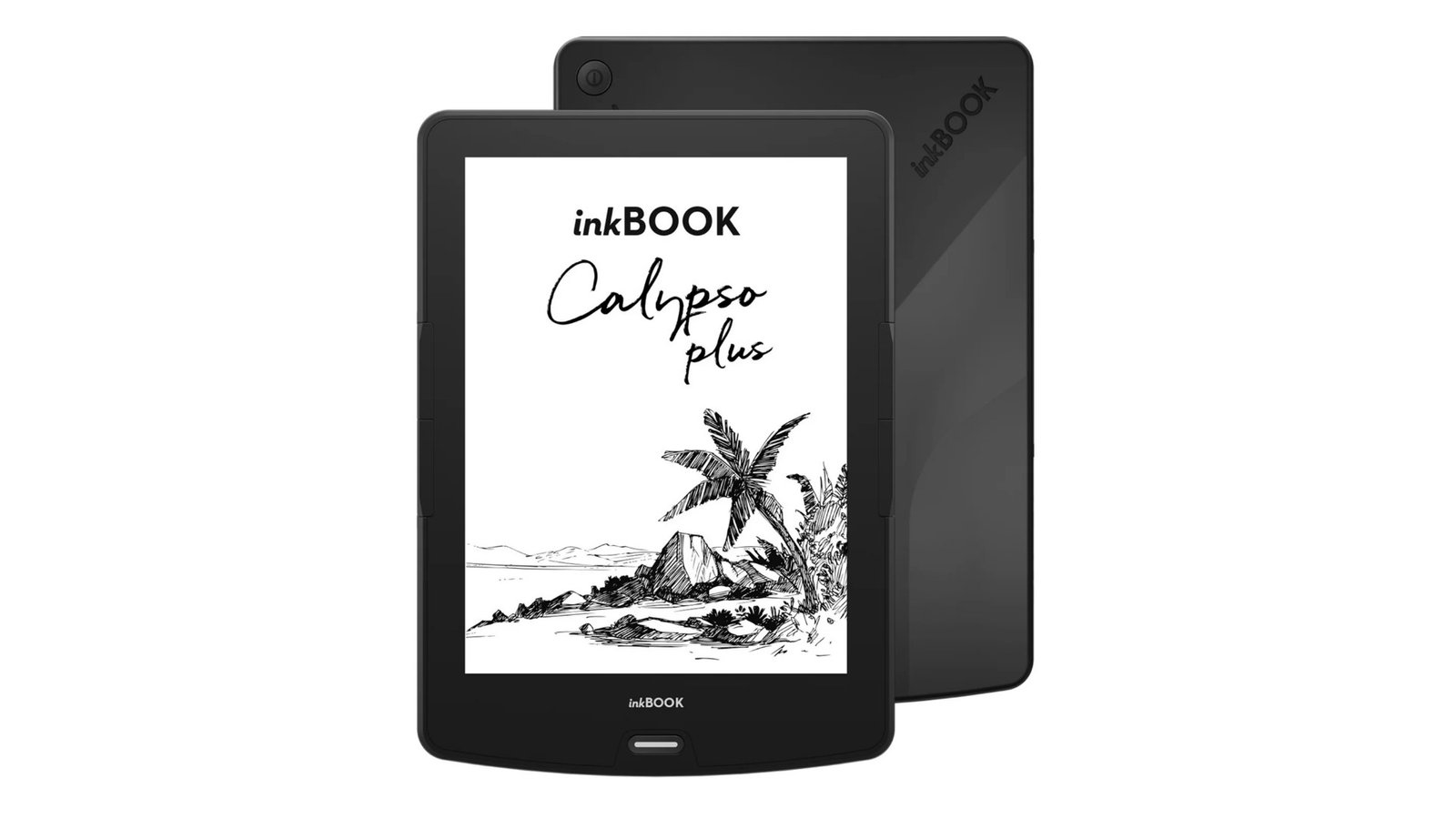
    The 6-inch screens are the most common and e-readers with this type of screen are generally inexpensive or relatively accessible financially.

    There is, for example, the Kobo Libra 2 which has a 7 inch screen which is very interesting and, among the competition, you have the Kindle Paperwhite and its 6.8 inch screen for a little less.

    But, you can choose even bigger by opting for an Inkpad 4 reader and its large 7.8 inch screen.

    Before going into details, we will focus on the particular case of the readers of about 10 inches (the diagonal screen of 10.3 inches being the most common).

    Large screen ereaders with a size of 10.3 inches and more

    Kobo Elipsa 2E

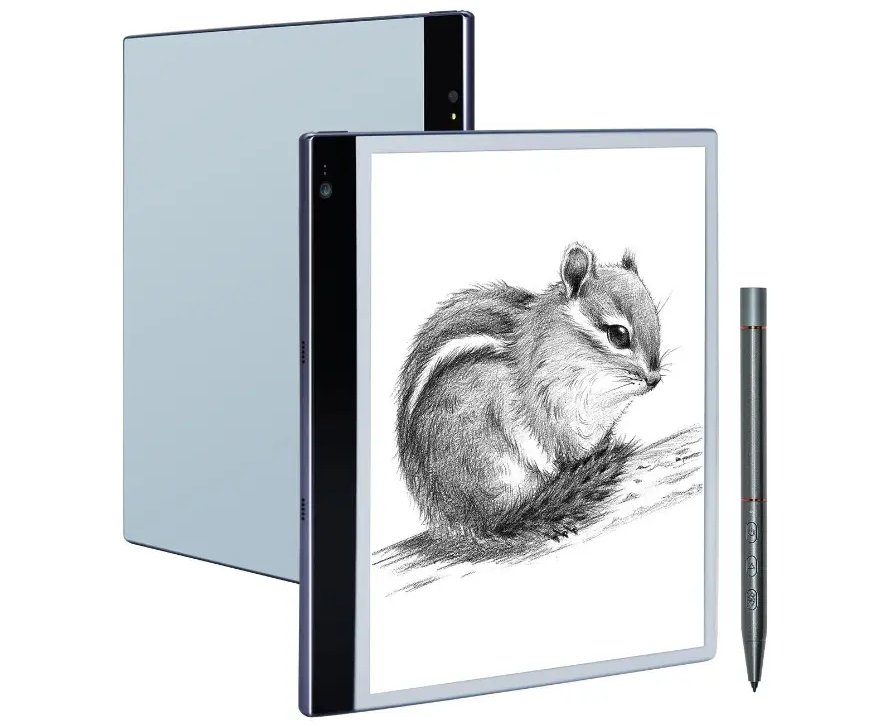
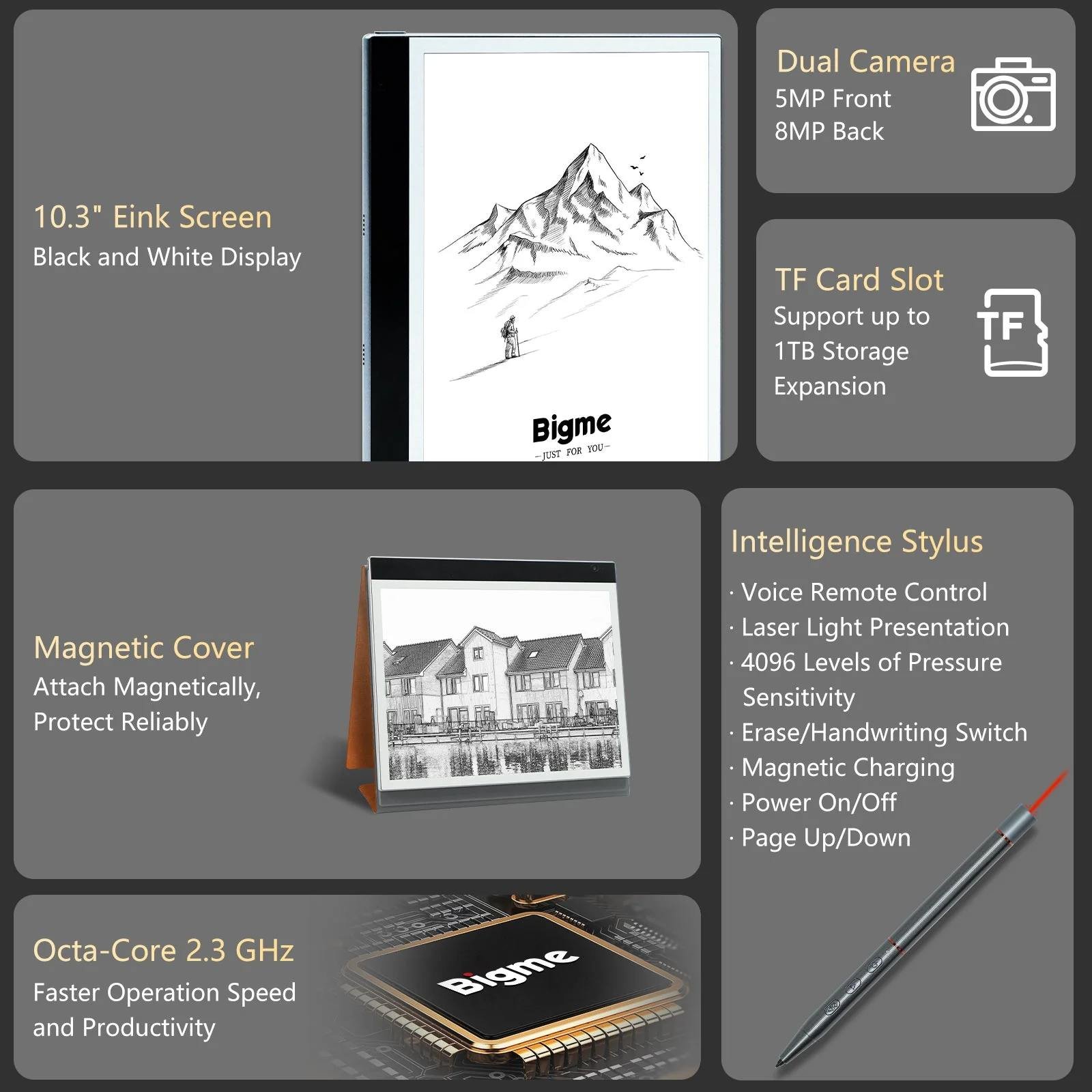
    Sometimes you can find on the market large screen ereaders that offer a large number of functions with a large screen with electronic ink (e-ink) with a diagonal of 10.3 inches and more.

    The main representatives available from the major e-reader brands are:

    While these are not necessarily bad readers, they work with a system that allows for additional features, such as note-taking with a stylus.

    They are full-fledged work tools that do more than just read ebooks.

    If the screen of these e-readers offers a very nice display surface, I think they are more intended for professional or academic use than exclusively for reading.

    They have the disadvantage of being very bulky compared to a simpler and smaller e-reader intended for reading (7.8" screen and smaller).

    That being said, they are very interesting for manga lovers or people who read PDF documents, since the large screen will allow to better appreciate the details of the pages without having to use the zoom.

    That’s why I don’t advocate 10.3" and large screen ereaders for reading ebooks.

    6-inch e-reader: the perfect size?

    Kindle e-reader

    The history of e-readers is littered with machines of different sizes.

    But, one thing that hasn’t changed in over 15 years of e-readers is that e-reader manufacturers all offer 6-inch models.

    There are many reasons for this:

    • e-ink screens are particularly reliable and offer a good resolution in 6 inches which allows to imitate very well the paper
    • a 6-inch screen consumes less energy than a larger screen
    • a 6 inch screen allows to create small and easily transportable e-readers
    • a 6 inch reader offers a screen size between a paperback and a large format

    In my opinion, these are the reasons why 6-inch e-readers have become popular and why there are now so many of them on the market.

    The 6-inch e-readers with e-ink screens offer a very comfortable reading experience, similar to paperback books, which makes them particularly easy to carry around.

    If you read in public transport (subway, bus, train, plane) or if you want to take a e-reader on vacation, it is a very good format.

    Their problem is that they are less interesting for manga readers.

    6.8 and 7 inches ereaders for more comfort

    Kobo Libra 2 : a great 7 inches screen e-reader

    In the 6.8-inch and 7-inch formats there are 3 interesting readers:

    This is a very comfortable and versatile screen format that allows you to read novels (ebooks) as well as mangas while keeping a small footprint that allows you to carry the reader without getting too bulky.

    So we have two diagonals of e-ink screens available in this format:

    • 6.8 inches
    • 7 inches

    So does 0.8 or 1 inch make a difference compared to a slightly smaller e-reader?

    Well, yes, with a slightly larger screen, it’s immediately more comfortable.

    Note that while the Kobo Libra 2 is larger (in size) than a 6-inch e-reader, the Kindle Oasis has a slightly different format (more square) that I find easier to carry around (but it’s also more expensive).

    So this size of e-reader is quite reasonable even for daily use and transportation on the bus, subway or train.

    Unfortunately, these ereaders are also more expensive – quite a bit – than the smaller versions. However, the Kindle Paperwhite with its 6.8-inch screen is still quite affordable.

    On the other hand, the same is not true for the 7.8-inch e-readers.

    Reader with 7.8-inch screen: for home and manga

    Pocketbook Inkpad 4

    Finally, we come to the last part with the 7.8-inch readers, of which the best current representative is the Pocketbook Inkpad 4.

    This format is mainly intended for home use – in my opinion – because of the size that the reader can take in a bag. Don’t worry, it is still possible to carry it of course!

    But, it’s really comfortable to have a 7.8 inch screen to read a good book in an armchair or a sofa.

    Another good news is that if you read a lot of manga (Japanese comics in small format and printed in black and white), this type of reader is quite suitable.

    Conclusion : which size of e-reader to choose ?

    e-readers with different screen size
    e-readers  screen size chart comparison

    In conclusion, here is what you need to remember to choose your e-reader:

    • 6-inch size: for everyone
    • 6.8 to 7 inch size: for the more affluent mobile reader who sometimes reads manga
    • 7.8-inch size: for home reading and manga
    • 10.3-inch size: for people who want a machine for reading and working (note taking)
  • Onyx Boox Poke 5 : a 6 inches Carta 1300 e-reader with Android

    Onyx Boox Poke 5 : a 6 inches reader with Android 11

    Onyx is a Chinese company which proposes e-readers with electronic ink and the Android operating system for a maximum compatibility with the applications of reading of ebooks. They have just launched the Onyx Boox Poke 5.

    The particularity of the Onyx e-readers is the presence of the Android system and the possibility of adding new applications with Google Play.

    This characteristic allows to install applications of reading proposed by the big actors of the ebook: Kindle and Kobo in head of list.

    This new Onyx Boox Poke 5 e-reader comes with a 6-inch Carta 1300 HD e-ink screen with a resolution of 1448 x 1072 pixels.

    The new Carta 1300 e ink screen is the real deal because it is one of the first e-reader to have it.

    The Onyx Boox Poke 5 has a touch screen (perfectly integrated "flush bezel" type, i.e. without edge with the case) and is devoid of buttons on the front – contrary to the competing models which tend more and more to propose at least two buttons to turn the pages (Kobo Libra 2, Pocketbook readers).

    In terms of lighting, this e-reader offers a color temperature adjustment system that adds a little warmth to the screen by offering a yellow / orange light softer for the eyes. This feature is supposed to reduce the negative effects of blue light on the body and eyes of the reader.

    See the ONYX BOOX e-readers on Amazon.com

    onyx boox poke 5 ereader android 11 carta 1300

    Here are the complete technical specifications of the Onyx Boox Poke 5 e-reader:

    • E Ink Carta 1300 HD screen, 6 inches, resolution of 1448 x 1072 pixels (300 dpi)
    • Touch screen with lighting and blue light filter
    • Qualcomm quad-core processor
    • RAM: 2 GB
    • Storage: 32 GB
    • Wifi
    • Bluetooth 5.0
    • Android 11 operating system (with Google Play)
    • Micro SD
    • Microphone
    • 1500 mAh battery
    • Weight: about 160 grams

    These features reveal two important points.

    First, there is a microphone and a Bluetooth connection that will allow to connect to the Onyx reader headphones or a speaker and, thus, enjoy reading audio books.

    Then, the capacity of the battery linked to the use of the Android system (more greedy in energy than the system of a reader dedicated to the reading) will make the autonomy of this Onyx Boox Poke 5 rather weak.

    Compared to a classic reader of a big brand like Kobo or Kindle, we can suppose that the autonomy will be 2 to 3 times weaker on this model of Onyx reader.

    It is thus a technical compromise to allow to have a compact and light reader while proposing the Android system and its great variety of available applications.

    The price of this Onyx Boox Poke 5 e-reader is $179.99 which is quite high. But, for this price, you will also have a protective cover with magnet to protect the screen, as well as the whole Android ecosystem (Google Play and Google services).

    It is therefore one of the most affordable reading devices on the market if you want to enjoy the many reading applications available for Android (ebooks, but also audio books and manga).

    As always, I have mixed feelings about these models of e-reader with Android. On the one hand, it's very nice to enjoy the numerous applications available. But, on the other hand, the reading experience has always seemed to me less good and less intuitive than with a "classic" e-reader fully optimized for this function.

    This Onyx Boox Poke 5 reader is thus to be reserved for the informed users who are at ease with the configuration of technological devices. The users who wish a simple and "turnkey" reading machine have all interest to turn to a brand of reader like Kindle, Kobo or Pocketbook.

    See the ONYX BOOX e-readers on Amazon.com

  • Bookeen Notéa: the e-reader from France soon available again!

    Bookeen Notéa e-reader notbook from France

    The Bookeen Notéa is a very successful machine in France and, to a lesser extent, in Europe. As a result, it is regularly out of stock and very difficult to find!

    Bookeen Notéa: a success… then difficulties

    After a successful launch in France, the Bookeen Notéa managed to convince not only readers but also professionals from all walks of life.

    With the ability to take notes on PDF documents, this machine has proven to be a valuable ally in the professional world where proofreading and editing documents is a daily task.

    In addition to its notepad functions, the large 10.3-inch screen allows demanding fans of novels and manga to sit at home and enjoy their favorite works in excellent conditions.

    This was enough to make people jump on this machine, as it was quickly sold out at Bookeen and later everywhere in France.

    We had to wait a few months to see new copies put on the market, which were also quickly sold out. All this was in 2021…

    Then, Bookeen encountered difficulties and was bought by Vivlio.

    Bookeen Notéa soon available with software updates

    Months have passed at Vivlio and a large part of the Bookeen team has been able to take its marks within the Lyon-based structure.

    Today Bookeen (by Vivlio) is ready to relaunch its flagship e-reader model as the return of the Bookeen Notéa is announced for the coming weeks at all usual Vivlio retailers.

    In addition to a new availability of the machine at a price of $419 ($400 – $450), the technical teams are also working on software updates that will apply to all owners of this Bookeen Notéa.

    In the US, it is a very rare reading machine that is hard to get. But if you are interested in this kind of digital notebook, you can look at the Kobo Elipsa 2E and the Kindle Scribe.

    You can look at the French review here :

    <iframe width="560" height="315" src="https://www.youtube.com/embed/jG0a8bY-WSA" title="YouTube video player" frameborder="0" allow="accelerometer; autoplay; clipboard-write; encrypted-media; gyroscope; picture-in-picture; web-share" allowfullscreen></iframe>

    <iframe width="560" height="315" src="https://www.youtube.com/embed/11K4UP-9QBY" title="YouTube video player" frameborder="0" allow="accelerometer; autoplay; clipboard-write; encrypted-media; gyroscope; picture-in-picture; web-share" allowfullscreen></iframe>

  • Pocketbook Inkpad Color 2 : 7.8-inches color e-reader

    Pocketbook Inkpad Color 2 e-reader

    The news keeps coming from Pocketbook with the announcement of the Pocketbook Inkpad Color 2 e-reader. As usual, Pocketbook updates the Inkpad Color with the latest technological advances by integrating a new Kaleido Plus color screen.

    Pocketbook Inkpad Color 2 as new 7.8″ color screen

    The Pocketbook Inkpad Color 2 comes just after the new Pocketbook Inkpad 4 with a color version that offers a more complete model for comic book lovers, while maintaining a large diagonal of 7.8 inches.

    The most important element, then, is this E Ink color Kaleido Plus screen that allows for more vivid and realistic colors. If the resolution in black and white is still 1404 x 1872 pixels (300 PPP), the color resolution is much lower: 468 x 624 pixels (100 PPP) with 4096 different colors displayable.

    The design of the e-reader follows the new Pocketbook codes and we still find the buttons under the screen that allow access to the main menu, options and page turning without having to press the touch screen.

    Other good news: the reader is waterproof with an IPX8 certification.

    As with the Pocketbook Inkpad 4, this Inkpad Color 2 offers many possibilities for reading audio books.

    First of all, the color e-reader offers a Bluetooth connection to connect headphones or an audio speaker.

    Secondly, there are speakers, which makes the reader autonomous and therefore does not require the purchase of additional audio equipment.

    And, in addition to reading many digital audio formats (M4A, M4B, OGG, OGG.ZIP, MP3, MP3.ZIP), the Pocketbook Inkpad Color 2 offers a text-to-speech function that allows you to transform classic ebooks into an audio book via software reading with a synthetic voice.

    These audio reading possibilities, the color screen and the large format of this reader make the Pocketbook Inkpad Color 2 very attractive for demanding book readers. It is also one of the most complete readers on the market.

    Pocketbook Inkpad Color 2 e-reader

    Rechnical specifications of the Pocketbook Inkpad Color 2 e-reader

    Here are the technical specifications of the Pocketbook Inkpad Color 2:

    • E Ink Kaleido Plus display, 7.8 inches, 1404 x 1872 pixels (300 PPP) black and white, 468 x 624 pixels (100 PPP) with 4096 different colors displayable
    • 1.8 Ghz processor
    • 1 GB RAM memory
    • 32 GB of storage memory
    • Bluetooth 5.2
    • Wifi
    • Speaker
    • USB-C
    • 2900 mAh battery
    • Waterproof with IPX8 certification
    • Ebook formats: ACSM, AZW, AZW3, CBR, CBZ, CHM, DJVU, DOC, DOCX, EPUB(DRM), EPUB, FB2, FB2.ZIP, HTM, HTML, MOBI, PDF (DRM), PDF, PRC, RTF, TXT
    • Audio formats: M4A, M4B, OGG, OGG.ZIP, MP3, MP3.ZIP

    Should you buy a Pocketbook InkPad Color 2?

    This new Pocketbook Inkpad Color 2 is a smart addition to the Pocketbook range, offering a large 7.8″ diagonal color screen.

    While the colors are still not perfect, the compromise is an interesting one, since this Pocketbook InkPad Color 2 is offered at a reasonable price (for a color reader) and allows color display while retaining the comfort of a larger-sized e-reader.

    Once again, we find the good build quality of Pocketbook e-readers, and great format compatibility. You can even load your own MP3 or OGG audio files onto the reader.

    Here’s a quick summary of the pros and cons of this Pocketbook InkPad Color 2 if you want to buy one.

    PROS

    • Price (considering it is a color e-reader)
    • Good build and software
    • Large ebook format compatibility

    CONS

    • Colors are not great (Kaleido Plus screen)

    Where to buy the Pocketbook Inkpad Color 2?

    There is a big problem: its price. Indeed, the Pocketbook Inkpad Color 2 price is $319.99.

    The price is high for a reading device, but its characteristics justify its price, provided that the color rendering is up to the mark…

  • HaxMini: the ultimate mini reader?

    haxmini e-reader

    A new Kickstarter project proposes a very interesting e-reader that goes against the current trend: the HaxMini e-reader is a small, easy to carry, affordable and functional e-reader.

    While most e-reader designers are starting to offer models with ever larger screens, color and even foldable, HaxMini is a e-reader with a small 5.83-inch screen, a powerful processor and – most importantly – a small footprint for easy carrying.

    The case of the HaxMini e-reader is reminiscent of those of higher-end e-readers like the Kobo Libra 2 or the Kindle Oasis. We find physical buttons on the sides of the screen (on the left this time) for a good grip.

    haxmini e-reader size

    In addition to its e-ink screen with a resolution of 648 x 480 pixels from another time, it should be noted that this HaxMini meets the needs expressed by many readers:

    • Presence of an expansion port for SD card up to 128 GB
    • Very fast quad-core processor
    • Android 8.1 with Google Play installed and allows the addition of Android applications (Kindle, Kobo, etc.)
    • Low weight of 155 grams
    • Dimensions of 138.5 mm x 113 mm x 6.8 mm
    • Night mode to display white characters on a black page
    • Native support for EPUB, PDF, MOBI, TXT and FB2 formats
    • 16GB of storage
    • USB-C charging
    • Wifi

    Of course, there are also some shortcomings compared to the e-reader models that have come out in recent years.

    The first is the resolution of the screen with 648×480 pixels. This reminds us of the cheapest 6-inch e-reader models released 10 to 5 years ago.

    Nevertheless, this should not hinder the experience of reading ebooks on such a small screen. But, it will seriously handicap the reading of PDF documents and manga.

    There is no lighting either, let alone a blue light filter. So, the Haxmini e-reader is a matter of compromise that will not suit all reading lovers.

    haxmini e-reader night mode

    That being said, this reader offers a very small footprint that makes it easy to carry around and it should be possible to easily add additional reading applications. This is an aspect that is difficult to find today on e-readers that all have a screen of 6 inches and more.

    The project is only in the funding stage and if all goes well, the Haxmini e-reader will be available this summer – in July – at a price of $138. But, you can get it for $79 by participating in the Kickstarter campaign.

    If your are looking for a very small e-reader, you can see this Woxter ereader review with a small 4.7-inch screen.

  • Readmoo prepares the first folding color e-reader

    readmoo folding color e-reader

    Readmoo is an Asian company that is starting to make a name for itself by adopting the latest technologies available to offer innovative reading machines.

    After announcing the Readmoo MooInk Plus 2C and its new Kaleido 3 screen, the company presented a prototype of a color e-reader with a folding screen designed in collaboration with the company E Ink, which offers the e-ink screen based on Gallery 3 technology.

    Not only is the screen foldable, but it is also color, with a diagonal of 8 inches and uses Gallery 3, a new way to display colors with electronic ink. It is thus a real innovation which is proposed here for a reader whose use will be undoubtedly dedicated to the mobile readers.

    Indeed, a screen of 8 inches offers a nice reading surface for a maximum comfort. The fact that this machine folds on itself – like the recent smartphones proposed by Samsung – makes the reader much easier to carry.

    One can easily imagine folding it and storing it in one’s bag at the end of reading in transportation.

    A foldable machine also has another advantage: the screen is protected when you are not reading. So there should be no need to add protection to the screen to keep it in shape (or a protective cover).

    The Galery 3 screen (based on ACeP: Advanced Color ePaper) will offer color display, which makes this machine particularly attractive.

    All this is as exciting as it is intriguing, although we’ll have to judge it on the spot. We know that smartphones that use foldable screens tend to be quite thick when folded. We may have this same feature with this Readmoo reader. If this is the case, it could affect the compactness of the machine and therefore make it less useful and easy to store.

    Still, this is only a prototype and, as always, it may never see the light of day. Readmoo and E Ink are nevertheless reassuring, because for both companies this is a reading device that will demonstrate their technological know-how.

    A know-how that could pave the way for other ever more innovative readers.

    Press : https://www.techbang.com/posts/105649-readmoo-cooperated-with-yuantai-technology-to-launch-the-eink

  • 4 cool and retro e-reader by Pocketbook

    While going back to the Pocketbook adventure, I came across some old models that were very interesting for their time. Here is a selection of e-reader models that had a short career and that have been sometimes forgotten.

    Pocketbook Mini e-reader

    Kobo had released a small format reader with a 5 inch screen, but the last one to be widely available was the Pocketbook Mini which was still available in 2013.

    It had a small 5-inch screen and a small format for a price that was really affordable at the time of about $70.

    Its small case made it easy to slip it in your pocket and carry it everywhere.

    It was the only small e-reader with the Kobo Mini and the last one in this format to have been widely marketed in the world.

    Pocketbook Color Lux e-reader

    In 2013, Pocketbook marketed one of the first color readers with the Pocketbook Color Lux.

    With its 8-inch e-ink screen capable of displaying 4096 different colors, it prefigured the more recent current e-readers based on a new generation of more powerful color screens.

    It was a small success and many readers swore by this model since it was the only one to display colors for years.

    Today, Pocketbook continues on this path and the Pocketbook Viva is the most recent evolution of this model.

    Pocketbook Aqua e-reader

    In 2014, Pocketbook launched the first waterproof e-reader with the Pocketbook Aqua.

    With its 6-inch e-ink screen it was thus largely ahead of its time with its IP57 certification that made it resistant to water splashes and dust.

    This feature has since been taken up by many brands who now all offer a waterproof model to allow reading in a bath, in the snow, by a pool or on the beach without fear for its reader.

    A Pocketbook Aqua 2 reader has also been realsed.

    Pocketbook Ultra e-reader

    The Pocketbook Ultra was a very disconcerting e-reader.

    It is a 6-inch e-reader with features that were way ahead of its time when it was released in 2015.

    Thus, it was one of the first models to offer a screen with an embryonic blue light filter. At the time of the test, I was totally baffled by the yellowish lighting of this e-reader.

    It should be noted that other manufacturers, such as Kindle, were pushing e-readers with ever-increasing contrast with machines like the Kindle Paperwhite that offered a more flattering display rendering with blacker text on an ever brighter screen.

    The flaw of the Pocketbook Ultra was to impose this blue light filter without any adjustment.

    But more than that, the Pocketbook Ultra offered another feature that was as original as it was revolutionary: a camera with a character recognition function.

    In other words, it was possible to take a picture of a page of a paper book and have a digital transcription using an OCR tool.

    Unfortunately, in practice the result was not up to expectations…

    Current lineup of Pocketbook e-readers

    You can see the current Pocketbook e-readers available on this page if you want to know wich is the best to buy.

  • Reading device for the visually impaired (ARMD), voice synthesis and other reading solutions

    e-reader for visually impaired ARMD

    Digital reading opens interesting perspectives for people with disabilities, especially for the visually impaired. We are going to see which reading devices and software solutions for visually impaired people exist on the market.

    If you have a visual acuity lower than 3/10, you are considered as a visually impaired person by the WHO.

    Reading text can therefore become very difficult. But, it is not impossible thanks to some technologies of which reading devices are part.

    In this article we will also talk about reading solutions for visually impaired people or for people with age-related macular degeneration (ARMD).

    Before going into details, I would like to specify that I am neither visually impaired nor blind. The information you will find on this page is therefore to be taken for what it is: information.

    The e-reader to enlarge the characters

    First of all, we have to start by talking about e-readers.

    These reading devices are financially accessible and allow the reading of digital books.

    In my opinion, their interest lies in two main things:

    • You can buy and download books easily without having to move and the ebook is often cheaper than its paper version
    • You can adjust the display on the screen to make the characters appear in a large font

    The cheapest e-readers are equipped with a 6-inch touch screen.

    The new Kindle is a good place to start, as it has an additional lighting feature that improves contrast and readability on the reader.

    But, for a visually impaired person, I suggest using a reader with a screen of at least 8 inches.

    Using the right font on e-reader

    Some fonts used by default on ebooks and e-readers are not necessarily suitable for reading for visually impaired people.

    One solution is to add fonts that are better designed for displaying text.

    Here is a selection provided by a visually impaired reader that should help you better discern the characters on your e-reader:

    Next, you will need to load this new font on your e-reader.

    Text-to-speech on e-readers

    On Pocketbook e-readers, and some Android readers, you can plug in headphones via a 3.5 mm jack or use headphones or a speaker with a Bluetooth connection.

    Then, it is possible to activate the text-to-speech function. The reader will read the text of the ebook in a somewhat robotic way.

    If we are still far from the diction of a human, it allows to have easily an audio version of a book not available in "audio book".

    We also have access to various sound settings such as the choice between the voice of a man or a woman, the selection of the reading speed and the adjustment of the sound volume.

    The audio book

    The audio book is obviously a solution for visually impaired or blind people.

    If the catalog is still far from being vast, the offer is increasing more and more because audio books are in fashion!

    The number one service in reading remains that of Audible which offers a free trial book for any registration.

    But you can find many free audio books on the Internet (click here to read the article).

    The tablet: not recommended

    I want to write a little word about tablets. Indeed, we can think that the idea is good since they are now a fairly large screen.

    However, they suffer from a major flaw for people with vision problems: the blue light generated by the screens is too important.

    I therefore advise against reading on a tablet, smartphone or computer screen.

    It is good to note that the e-readers with lighting also generates blue light but in lesser quantities.

    Note that there is software on tablets to reduce blue light. However, these are not always effective and they make reading more difficult because the screen becomes less contrasted.

    Text-to-speech software

    More and more smartphone applications offer a text-to-speech application.

    Because, if it is better not to read on the screen of the smartphone (or a tablet), nothing prevents it from being used to access the text-to-speech function.

    The list of applications that offer this function is long, but be aware that it is available in the "Google Books" application, installed by default with most Android smartphones.

    This feature has appeared on other devices such as the Alexa personal assistant and its Echo devices that will text to speech on your Kindle books.

    The Braille reader

    Canute 360 Braille reader

    Finally, there is a last device called Canute 360, which is a Braille reader capable of displaying 360 characters.

    For the moment, the reader is not available for everyone because it is still a test.

    Its commercialization being imminent, it could offer a very interesting solution for people who want to read Braille ebooks.

    Conclusion: the best e-readers for the visually impaired

    Today, digital technology offers more reading solutions for visually impaired people. But it is still not enough.

    Indeed, accessibility is both difficult and easy to implement in digital devices.

    We have seen in this article that software and reading devices allow to do text-to-speech. So we wonder why all ebook reading systems are not equipped with it!

  • How to read manga on Kindle?

    e-readers mangas

    I will show you where you can find manga and how you can download them and read them on your Kindle e-readers.

    First of all, the reading of digital manga is exploding in the world. It is particularly noticeable in Japan where there are more readers of digital manga than paper ones.

    But, I think that the "manga ebook" has also the possibility to develop widely outside Japan.

    Indeed, because of the absence of color, digital manga weighs less to store than other comics. Moreover, as they are already published in a small format in paper version, e-readers with a screen with a high resolution are at ease for their display (even in 6 inches).

    If we add to this the available 7 and 8 inch e-readers and low cost touch tablets, we can think that manga can make a nice digital place in our reading devices.

    The problem now is that we don’t necessarily have digital versions of all the manga that are released…

    The Kindle Library

    Kindle softwares

    At Amazon, there is a comic book section that allows you to see, on a case-by-case basis, if the volume you are looking for is available on the Kindle e-reader (or the reading application on tablet, smartphone or PC/Mac).

    For popular series like Naruto, the digital version costs $4.99 compared to $6 for the paper version. So that’s a nice savings of almost $2 per episode.

    What is not bad is that you can search directly and only in the mangas that are available in digital using the search engine of your Kindle e-reader (or on Amazon).

    So you can find a lot of things, even if everything is not yet present. I also noticed that recent releases tend to come out in digital too.

    So, reissues like GUNNM, have their digital version.

    Prime Reading or Kindle Unlimited

    With Amazon, you can subscribe to a service like Prime or Kindle Unlimited.

    Kindle Unlimited offer the larger choice but you’ll have to pay a small fee each mounth to access the books and the mangas available.

    If you have an Amazon Prime membership, you can access to a catalogue of free ebooks and mangas and the Prime Reading (read this article to know more about it) section of the Kindle Library on your Kindle e-reader. (no extra fee if you already a Prime customer)

    Transfer PDF, CBR and CBZ files to your Kindle e-reader

    CBR and CBZ on Kindle

    If you’re interested in digital comics, you’ve probably come across files in slightly exotic formats like CBR or CBZ. Here’s how to convert them to PDF.

    > Note : there is a full tutorial on the website to help you read CBR et CBA on Kindle and Kindle Paperwhite (click here).

    The CBR or CBZ format requires the use of special software to read them.

    Fortunately, thanks to Calibre you can transform these files into PDF files that are easier to use on your different devices: e-readers, tablets, smartphones, PC and Mac.

    The advantage of using Calibre to do the conversion is that it offers optimizations regarding the images, in order to display the comics more clearly on a reader (with a black and white screen). But, you can also use another software to do the conversion.

    The first thing to do is to install Calibre if you don’t have it on your computer yet. You can go to this site to download it: https://calibre-ebook.com/fr/download

    Now you have to import your CBR or CBZ file into Calibre.

    You can now transfer PDF, CBR and CBZ to your Kindle device.

    If you wan to choose the right e-reader for reading manga you can read this article.

  • Latest news about e-readers

    You can find a lot of informations about e-Reader from all brands on this website.

    Here is all the latests news, articles, reviews and guides about e-readers:

    !LISTE!