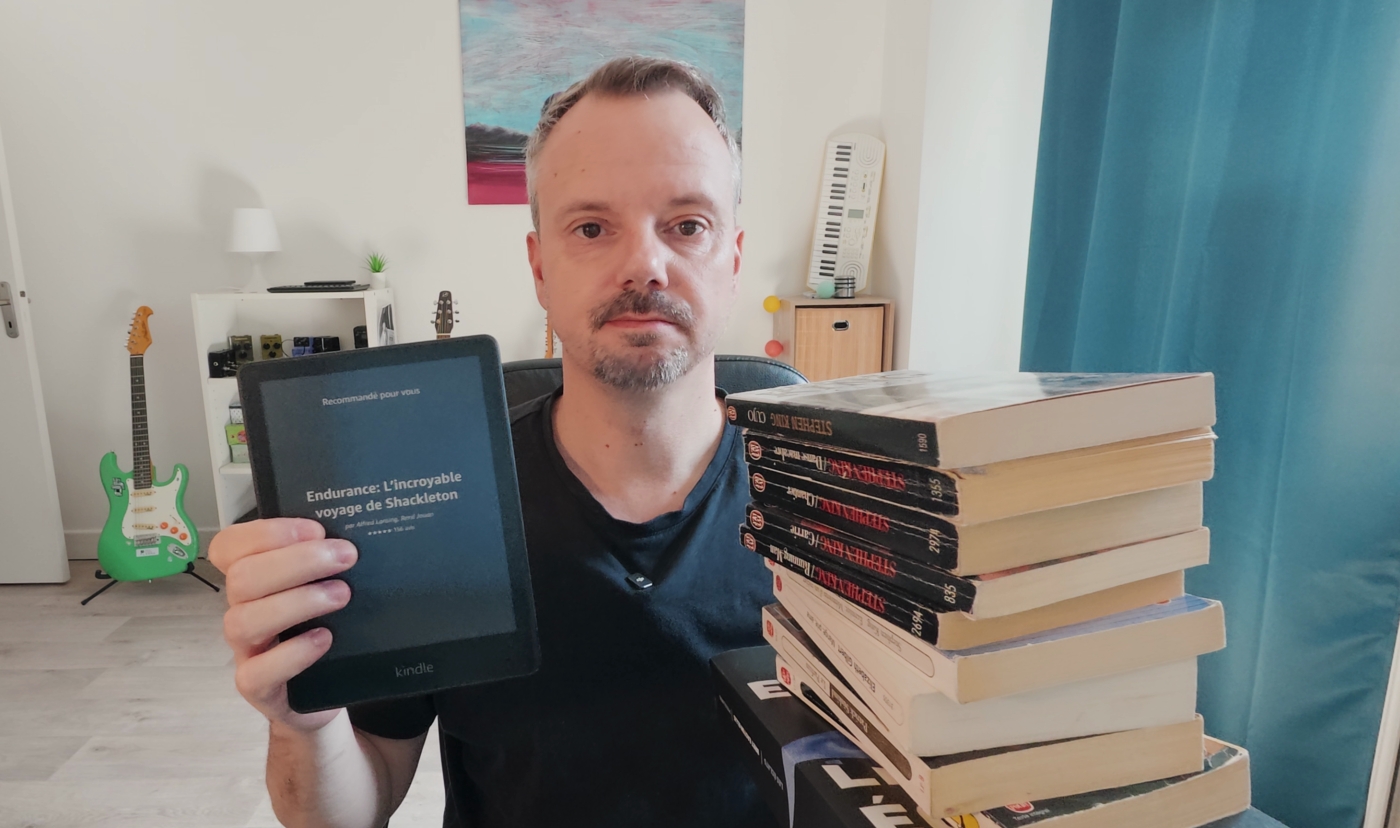
An e-reader will cost you between $100 and $200 for a device that does one single thing: let you read. Meanwhile, the smartphone already in your pocket can read ebooks for free, starting tonight. You may also have a tablet lying around somewhere, and a healthy stack of paper books waiting on the nightstand. So the question is perfectly fair: is it worth it?
TL;DR: An e-reader costs $100 to $200 and does exactly one thing: display text. Your phone is free and already in your pocket. So here is the honest answer. The one advantage no phone or tablet can ever match is the screen itself: E Ink is lit from the edges and reflects light back at you, like paper, instead of shining it straight into your eyes. Ebooks also save you real money on new releases ($10 to $15 a book) and classics are free, though savings on older paperbacks are close to zero. The downsides are real too: color is still washed out, you are locked into one store’s ecosystem, and you will never build a beautiful shelf in your living room. Bottom line: if you read more than 10 books a year, read in long sessions, read at night, or travel a lot, an e-reader pays for itself fast. If you read two or three books a year, or mostly color comics and magazines, save your money and use a phone or a tablet.
In this article we go through the real advantages, the real drawbacks, and at the end I tell you plainly who an e-reader is worth it for, and who is just wasting money.
This article is based on a video published on my French YouTube channel:
1. The number one argument: e ink does not tire your eyes
This is the genuine advantage that no smartphone and no tablet will ever be able to offer you. And it comes down to physics, not marketing.
The difference is in the type of screen and the way it is lit.
E-readers use an electronic ink screen that displays characters in a way that is very close to paper.
On a phone or a tablet, the screen is backlit: light is produced behind the panel, passes through it, and hits your retina directly. That is exactly what creates the eye strain you feel after a long session, especially at night in a dark room.
On an e-reader screen the light is reflected before it reaches your eye, which is not the case on a tablet and its backlit display.
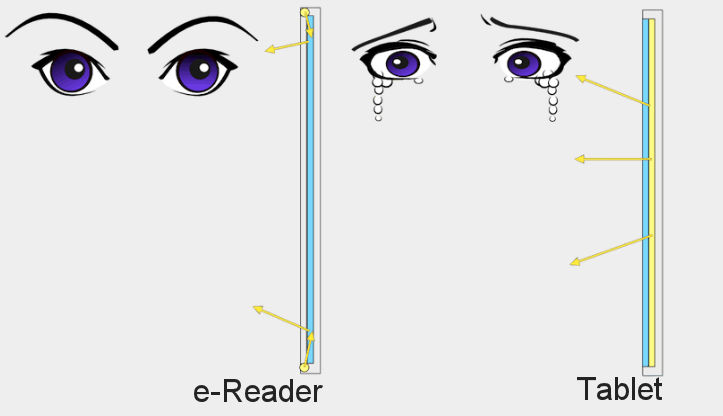
On an e-reader, the process is reversed. The LEDs sit along the edges of the screen, and the light is projected toward the panel. It lights up the electronic ink, then it is reflected back toward your eyes. It works exactly like a bedside lamp shining on a paper page.
That is the whole difference: you are not looking at a light source, you are looking at a lit surface.
Bonus: on almost every e-reader you can simply turn the light off. At that point it is the sun or the room’s own light hitting the electronic ink, exactly like a paper book. Where your tablet turns into an unreadable mirror at the beach, the e-reader is at its very best.
2. The money argument: ebooks cost less
Ebooks do cost less, but how much you save depends enormously on what you read.
New releases: $10 to $15 saved per book
This is where the gap is widest. A new hardcover that goes for $30 in a bookstore regularly costs $10 to $15 less in its digital version. If you read a lot of new releases, the math is easy: the e-reader pays for itself quickly, often in under a year.
Older books: a few dollars, sometimes a few cents
On backlist titles in paperback, the gap narrows sharply. Depending on the title, we are talking about a few dollars, sometimes a few cents. If you mostly read mass market paperbacks, do not buy an e-reader “to save money”: that is not where the value is.
Classics: they are free
This is the most underrated saving of all. Every book that has fallen into the public domain can be downloaded for free and legally. Mark Twain, Jane Austen, Charles Dickens, Herman Melville, Edgar Allan Poe. You can grab them straight from the store built into your e-reader, or from specialized sites like Project Gutenberg and Standard Ebooks.
If you love the classics, your digital library fills up without spending a cent.
3. “I already have a smartphone”: that might be a good argument (or not)
Let’s be honest: sometimes an e-reader is not necessary, and a phone is plenty. As I have been saying for nearly 15 years, the important thing is to read, whatever the medium.
The deciding factor is not the number of books you read, it is the way you read.
If you read half an hour to an hour a day, but in fragments, in 15 or 20 minute sessions (on the train, in a waiting room, before falling asleep), your phone does the job just fine. Install a reading app and you already get the price advantage of ebooks without buying a single extra device.
On the other hand, as soon as you read continuously, an hour or two at a stretch, the difference in comfort becomes impossible to ignore. That is exactly where an e-reader earns its price.
4. E-reader, paper, tablet or phone: the honest comparison
| E-reader | Paper book | Tablet | Smartphone | |
|---|---|---|---|---|
| Eye comfort (long session) | Excellent | Excellent | Average | Poor |
| Reading in bright sunlight | Excellent | Excellent | Bad | Bad |
| Reading at night without disturbing anyone | Excellent | Needs a lamp | Fine but tiring | Fine but tiring |
| Cost of books | Lower, sometimes free | The highest | Lower | Lower |
| Comics, manga, magazines | Limited (see below) | Ideal | Ideal | Too small |
| Bulk when traveling | Thousands of books | 1 or 2 books | Good | Excellent |
| Pleasure of the object | Low | Maximum | None | None |
5. The real drawbacks (rarely spelled out clearly enough)
An e-reader is not perfect. Here are the four limits you should know about before buying.
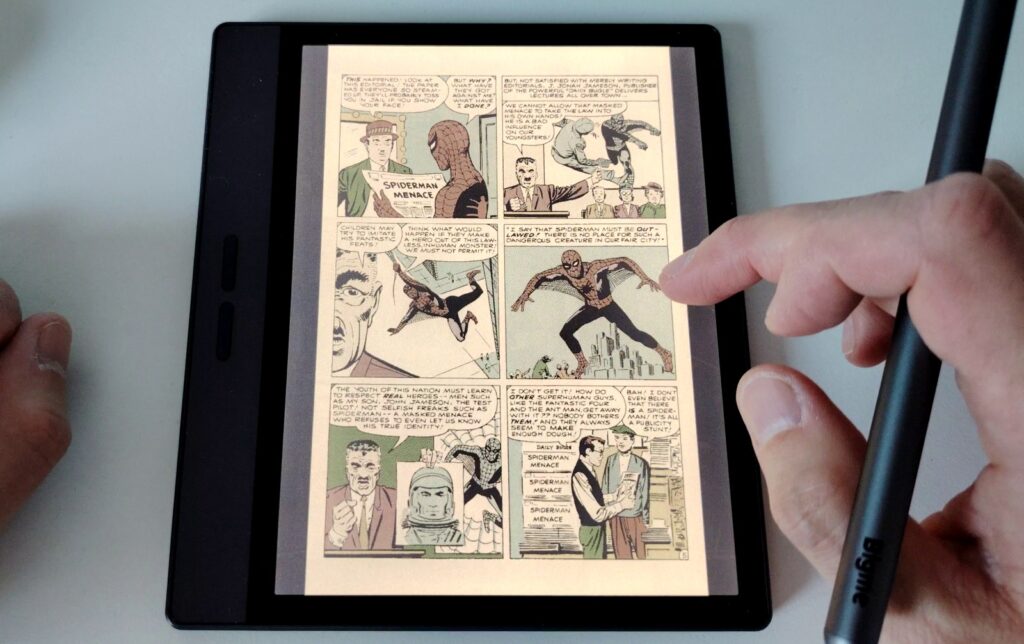
Color still is not there
Color e-readers exist and they get better every year, but in 2026 the color reproduction is nothing like an iPad or a phone. The tones are dull, a little washed out.
In practice: if your goal is to read magazines or color comics, you will be disappointed. This is the one area where the e-reader clearly loses to a tablet.
An important nuance for manga: in black and white, from a 7 or 8 inch screen upward, the experience is genuinely very good. If you are a heavy manga reader, it is at least worth a try.
You are locked into an ecosystem
A Kindle buys Kindle books. A Kobo buys Kobo books. A Pocketbook buys Pocketbook books. Your purchases stay tied to the brand you picked, and that is a real thing to weigh before you buy.
Two things soften that, though:
- Public domain books and files downloaded elsewhere escape this logic entirely.
- As long as the ecosystem suits you, the experience is fairly comfortable: your whole library is there, at any time, on the e-reader and in the phone app.
You will not build a beautiful bookshelf in your living room
This is the emotional point, and it is a perfectly fair one. Rows of spines lined up by the dozen, beautiful covers, the smell of paper: none of that with an e-reader.
That said, there is a trade-off people often forget: space. Personally, that is what convinced me to adopt an e-reader alongside paper. I am not only saving on the price of books, I am also saving on the furniture needed to store them. It sounds odd, but when the shelves overflow, that is a very real cost.
It is one more device to charge and carry
One more gadget, one more outlet, one more thing not to forget. Nothing dramatic, battery life is measured in weeks, but it belongs in the balance.
6. So who is an e-reader really worth it for?
Here is how to tell whether you actually need one.
✅ Yes, buy an e-reader if…
- You read more than 10 books a year. No argument here: the device pays for itself quickly, especially if you read new releases.
- You read in long sessions. This is the use case where the comfort of electronic ink pulls ahead.
- Your eyes tire easily or you need to enlarge the text. Being able to set the font size freely is a comfort paper simply cannot offer.
- You read at night, in bed. The e-reader’s own light is more than enough: no more bedside lamp, so no more waking your partner.
- You travel. Instead of packing two books, getting bored with the first, devouring the second and then desperately hunting for something to read, you just download whatever you want, wherever you are.
- You love the classics. An entire library, free.
My take after years of use: over a long reading session, the comfort of an e-reader is better than a paper book. That is debatable, but it is my experience.
❌ No, skip it if…
- You are an occasional reader (two or three books a year): a reading app on your phone will do the job perfectly.
- You mostly read comics or color magazines: a tablet is still the better choice.
- You are deeply attached to the physical book, the covers, the spines, the shelf filling up. In that case an e-reader really does risk ending up in a drawer.
One honest note on that last point: I have met a lot of committed, paper-only readers who, after giving it a try, ended up leaving paper behind for the most part. I still buy paper copies from certain authors whose releases I collect. The two are not mutually exclusive; an e-reader does not necessarily replace paper, it gets added to it.