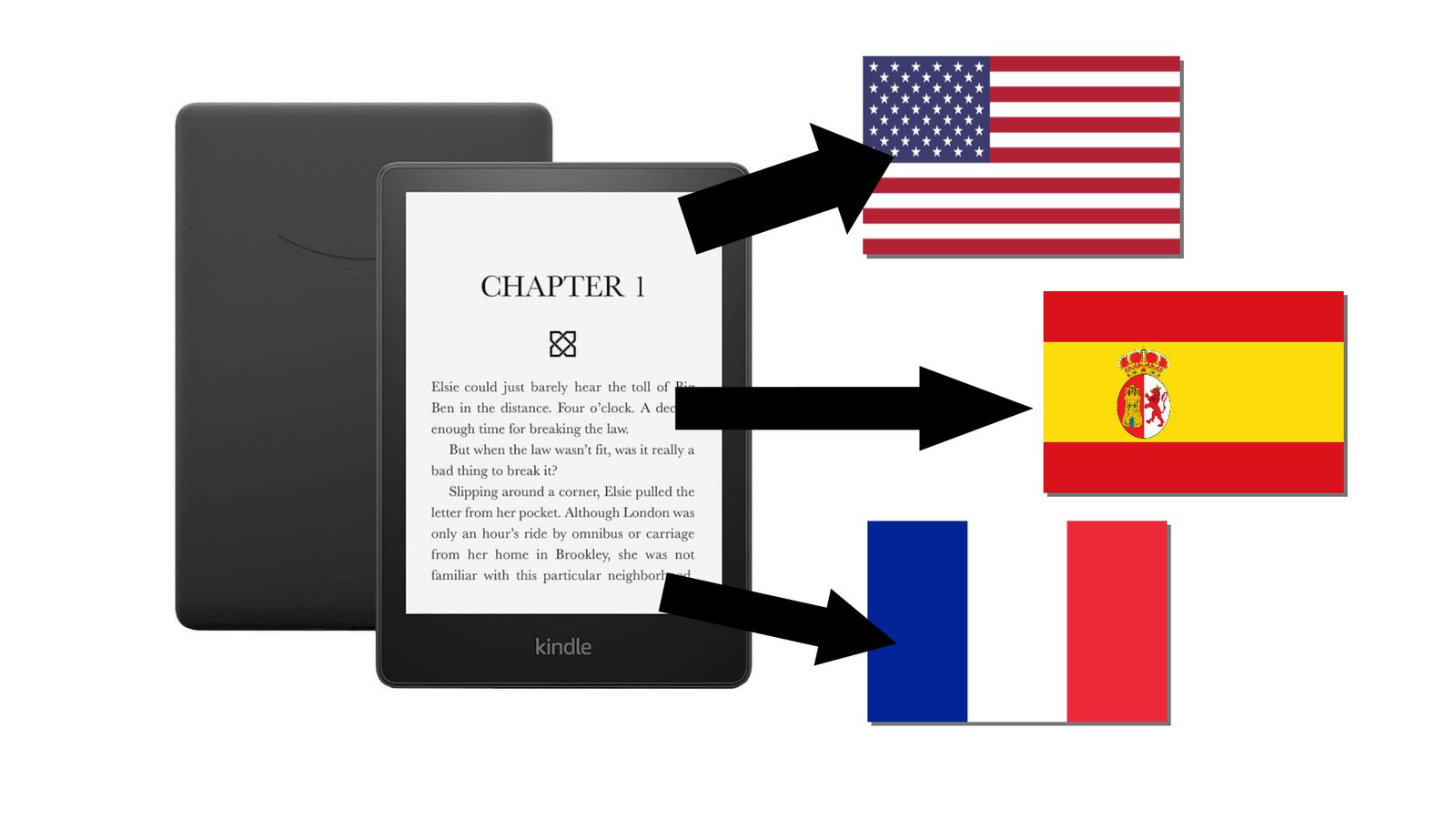
E-readers support different languages, allowing you to change the interface text. Let’s take a look at how to change the language of a Kindle e-reader.
On a Kindle ereader, you can change the language of the interface (texts in menus), change the keyboard layout (from qwerty to azerty, for example) and add dictionaries.
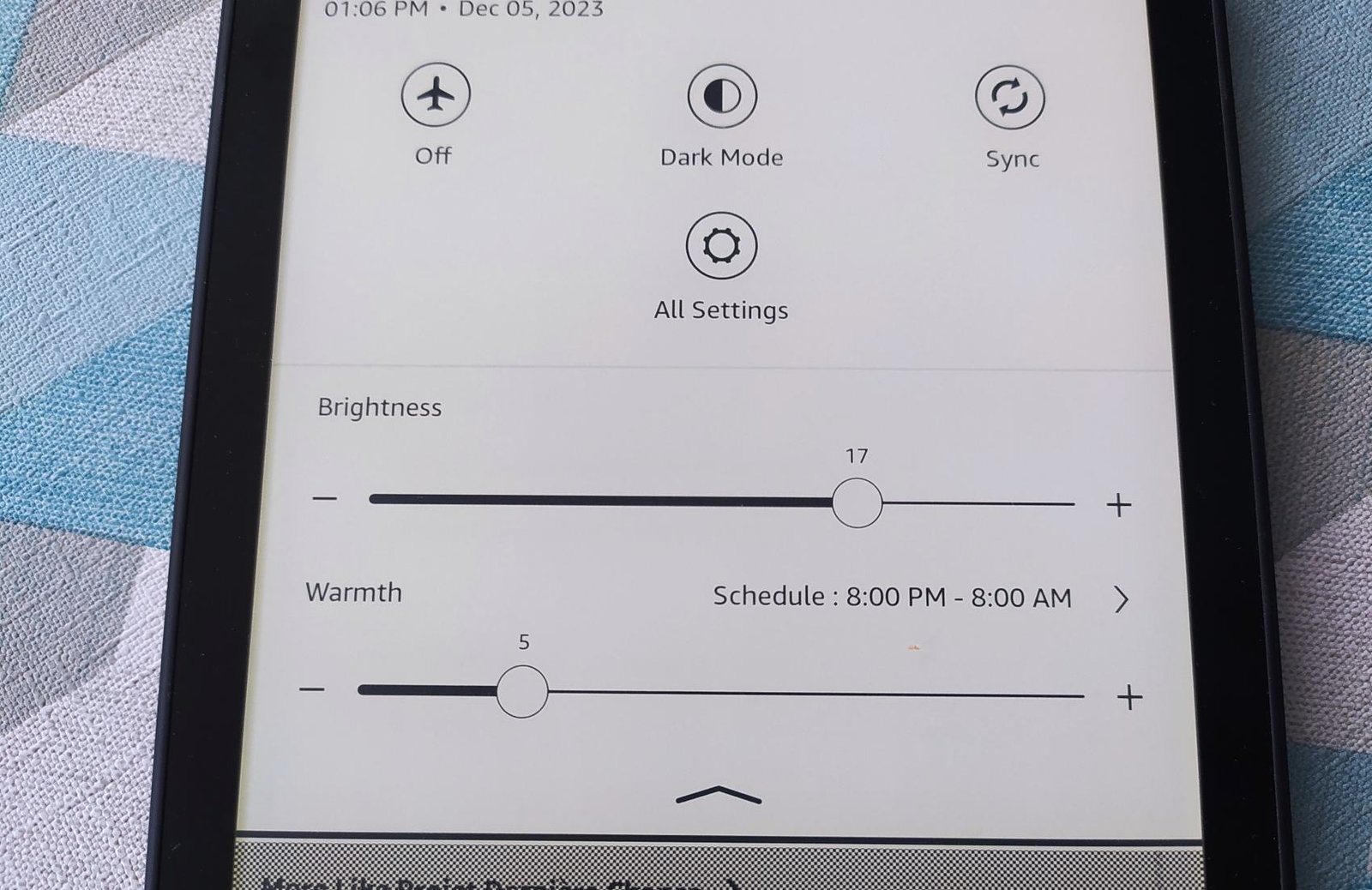
To manage these options, go to Settings. Unfold the menu at the top of the home screen and press "All Settings":
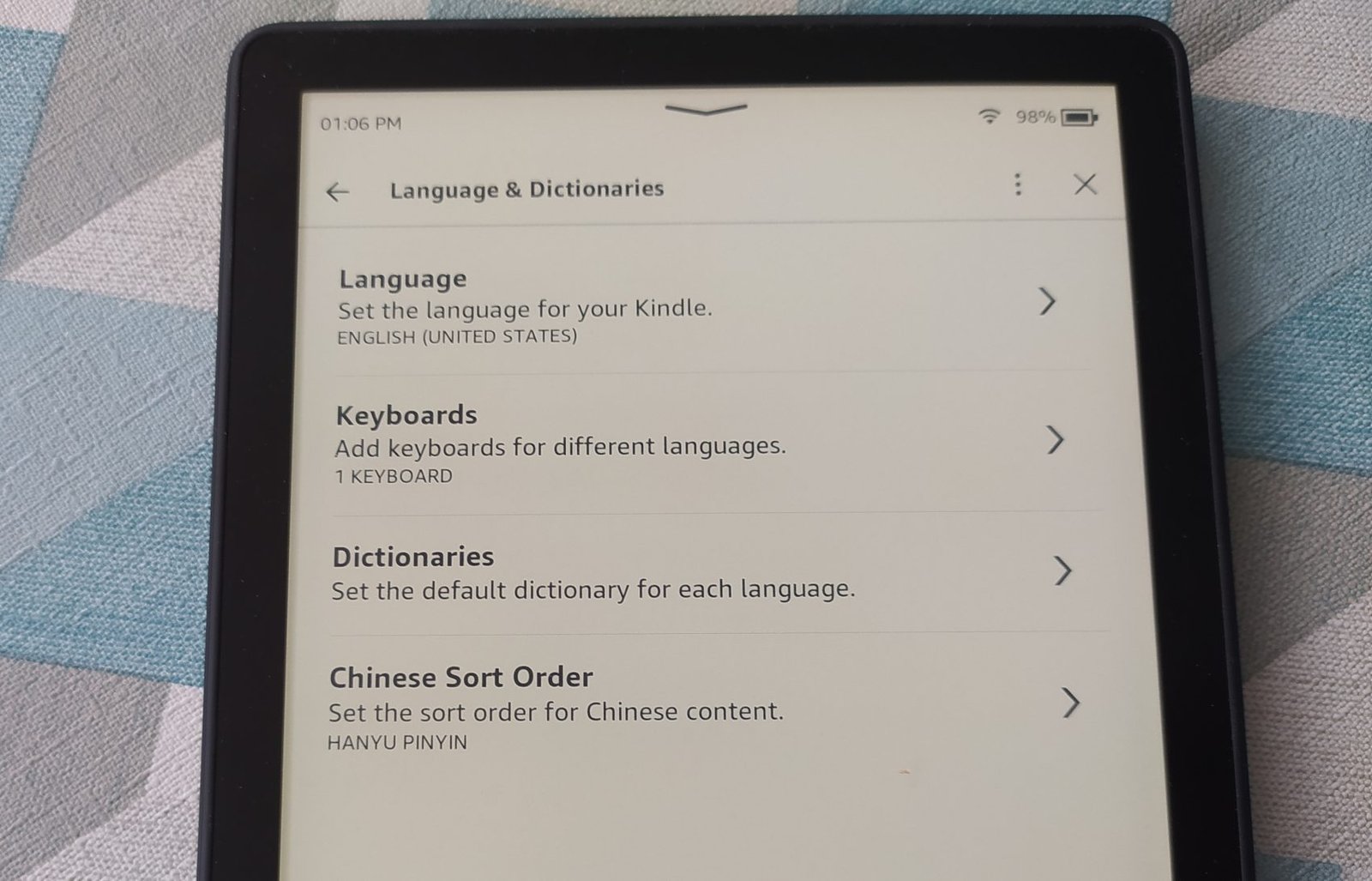
Next, go to Languages & dictionaries:
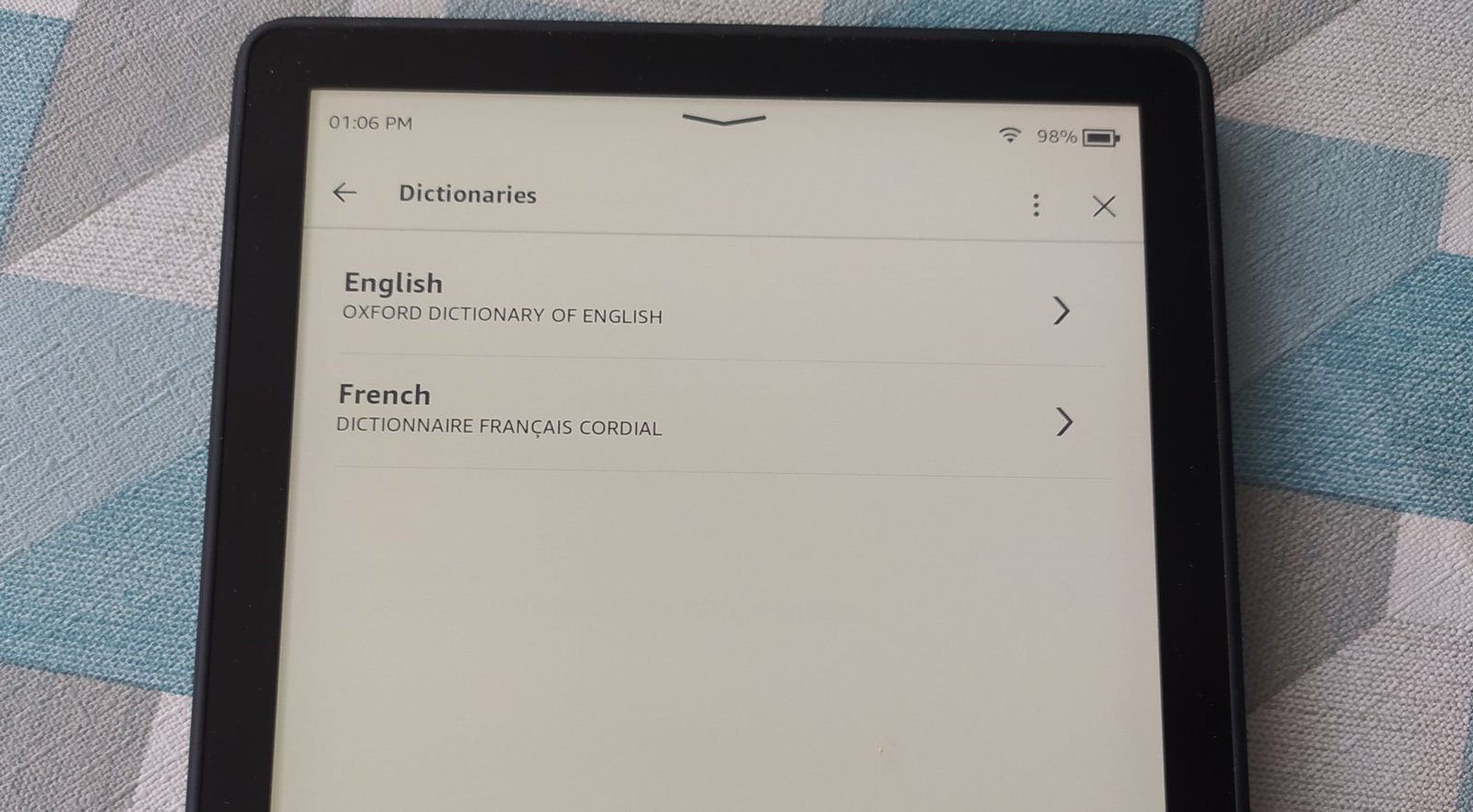
In this new screen you can change the language of the Kindle e-reader, but also modify the keyboard layout and add dictionaries (beware, for some modifications you’ll need a Wifi connection).
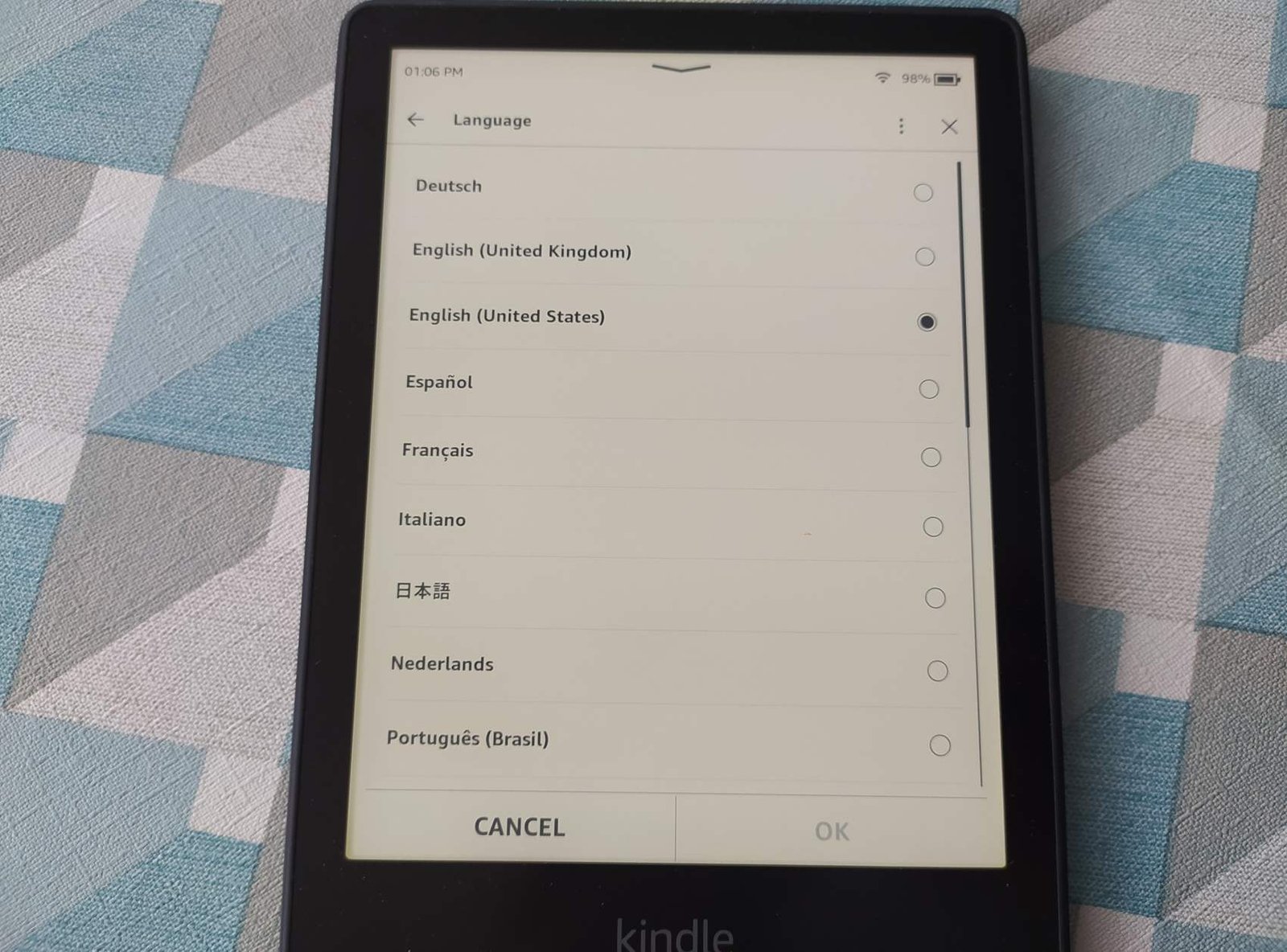
To change the language, click on Languages:
The new screen lets you choose the language from among these:
English,
German,
Italian,
Spanish,
Dutch,
Portuguese,
French,
Polish,
Chinese,
Japanese
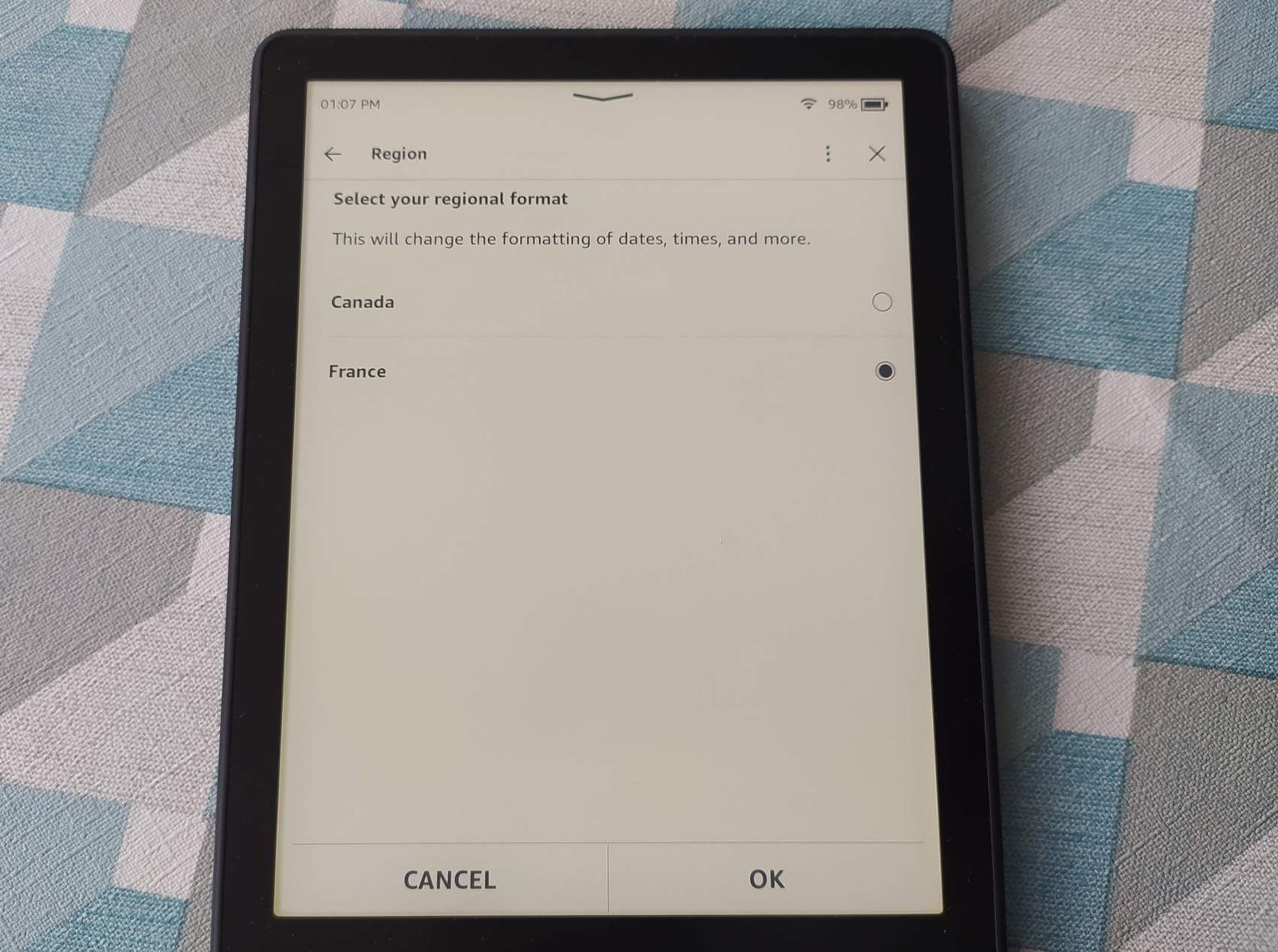
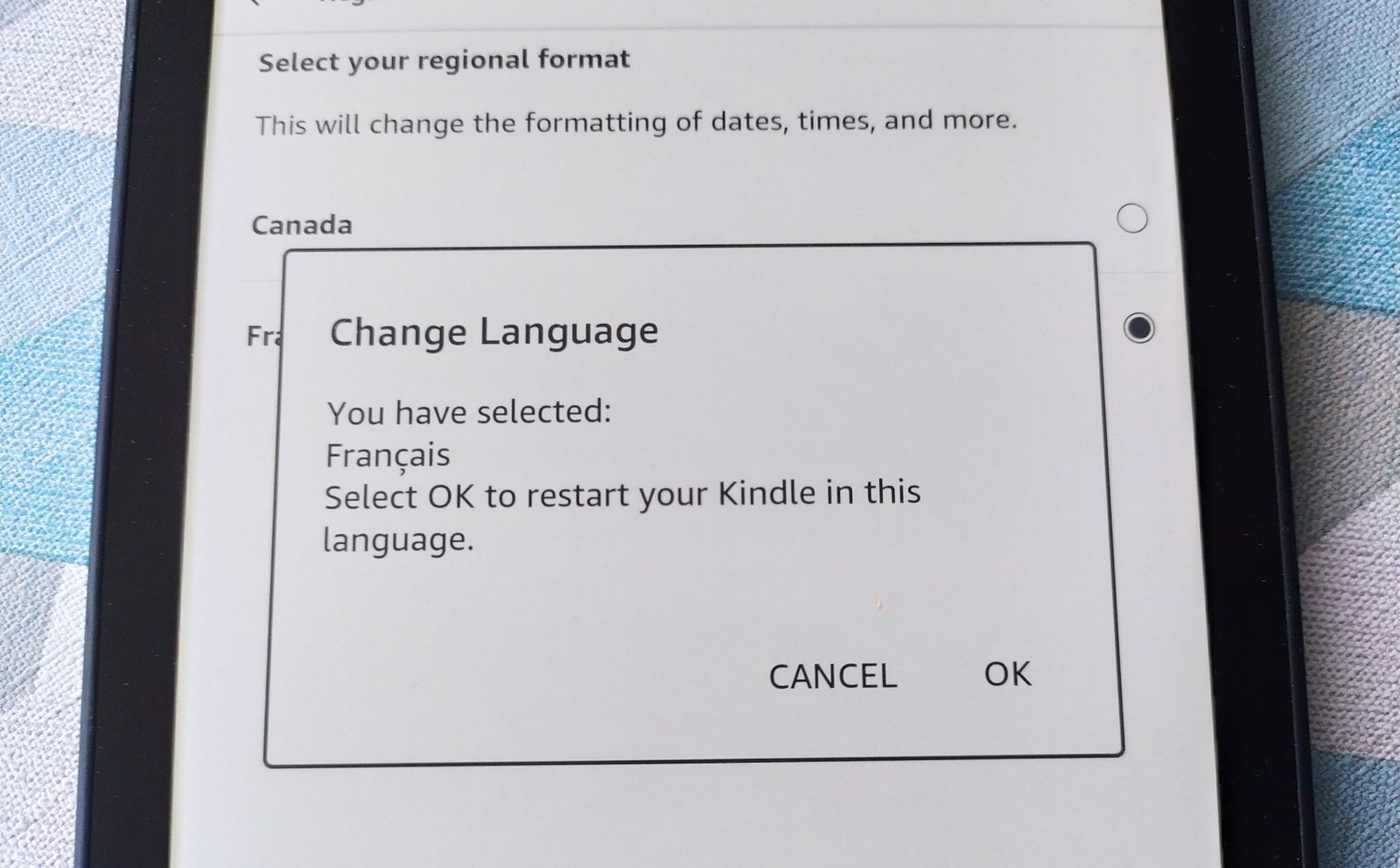
You can now select the language of your choice. Sometimes you’ll need to choose a language variant (for French, you’ll need to choose between France and Quebec/Canada, for example).
For your Kindle’s new language to take effect, you’ll need to restart your e-reader (this will be done automatically).
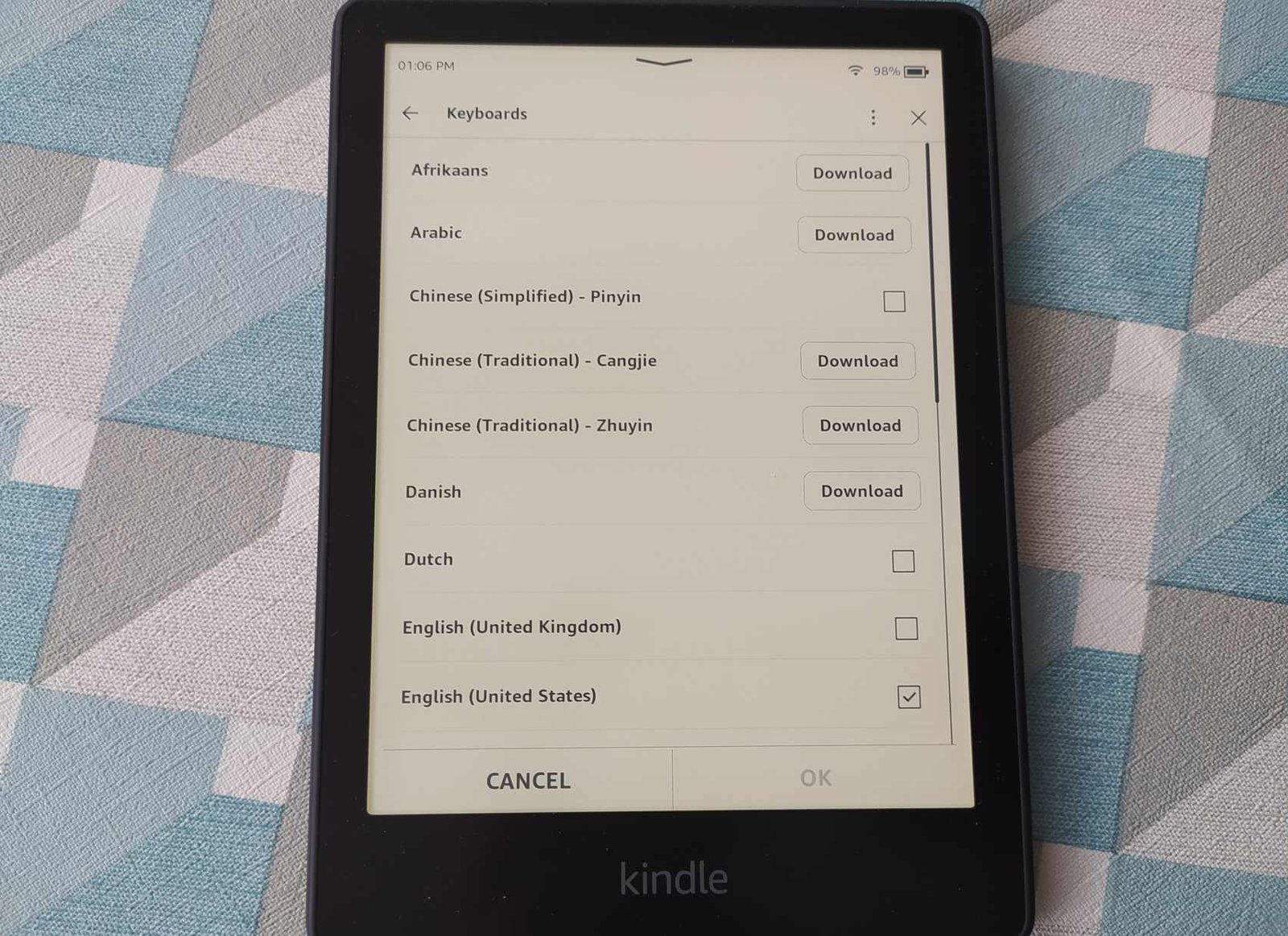
In addition, you can choose your keyboard layout (although this will be automatically selected with the Kindle language):
As you can see from the screen above, you’ll need to download some keyboards that are stored in the Amazon cloud. You’ll also need to connect your Kindle to the Internet via Wifi.
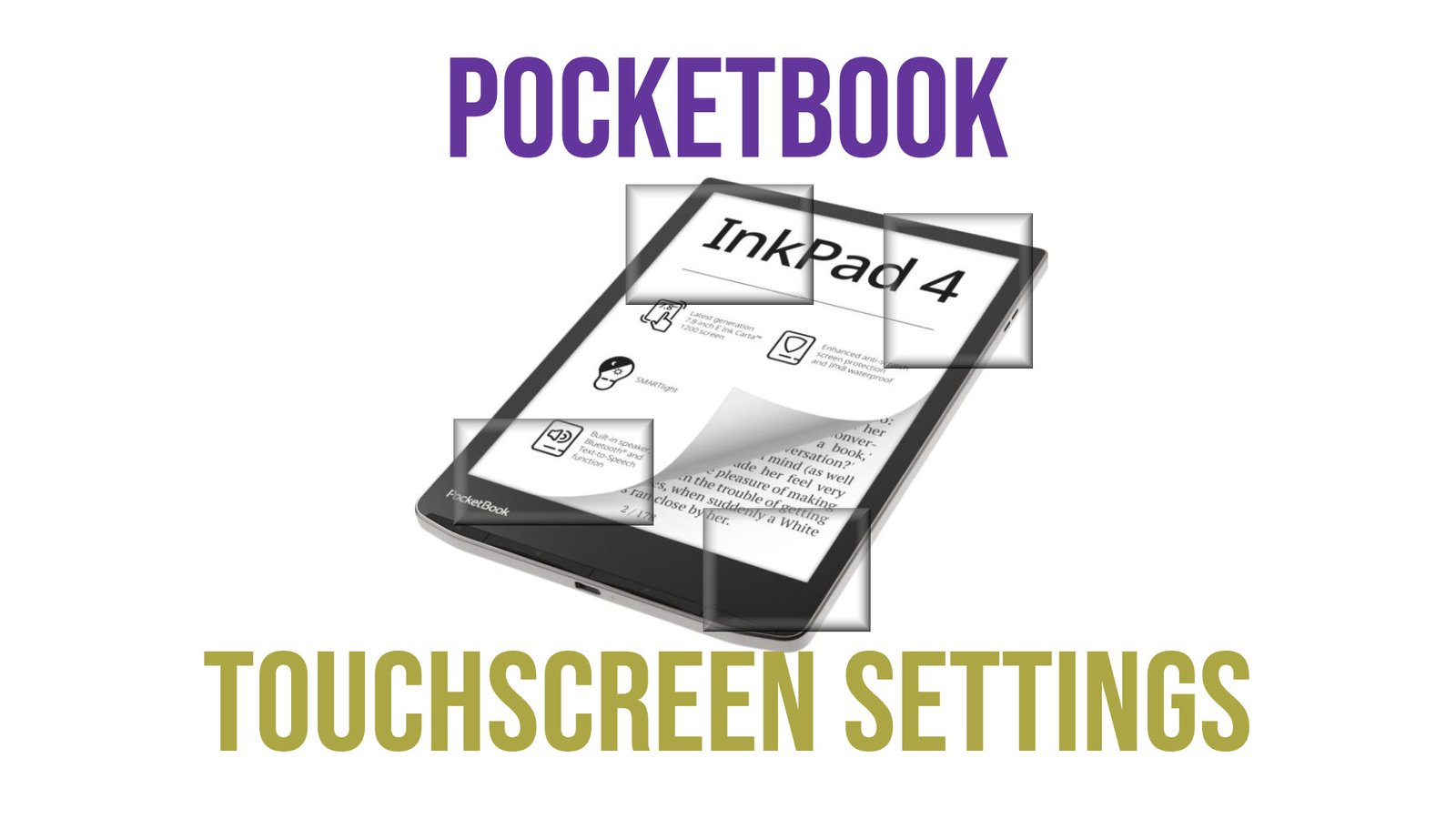
Pocketbook e-readers have the most comprehensive software available. It’s so complete that you often miss out on some very interesting features. In this article, I’ll explain how to set and customize the touchscreen on your Pocketbook ereader.
On Pocketbook e-readers, you can configure the touch screen in reading mode to add actions to be performed when you touch it.
For example, you can tell the ereader to display the next page of the ebook if you touch the right-hand side of the screen. You can also tell it to display the text settings menu when you touch the bottom of the screen – and so on.
It’s even possible to deactivate the reader’s touch functions, which can be interesting since Pocketbook ereaders have buttons underneath the screen.
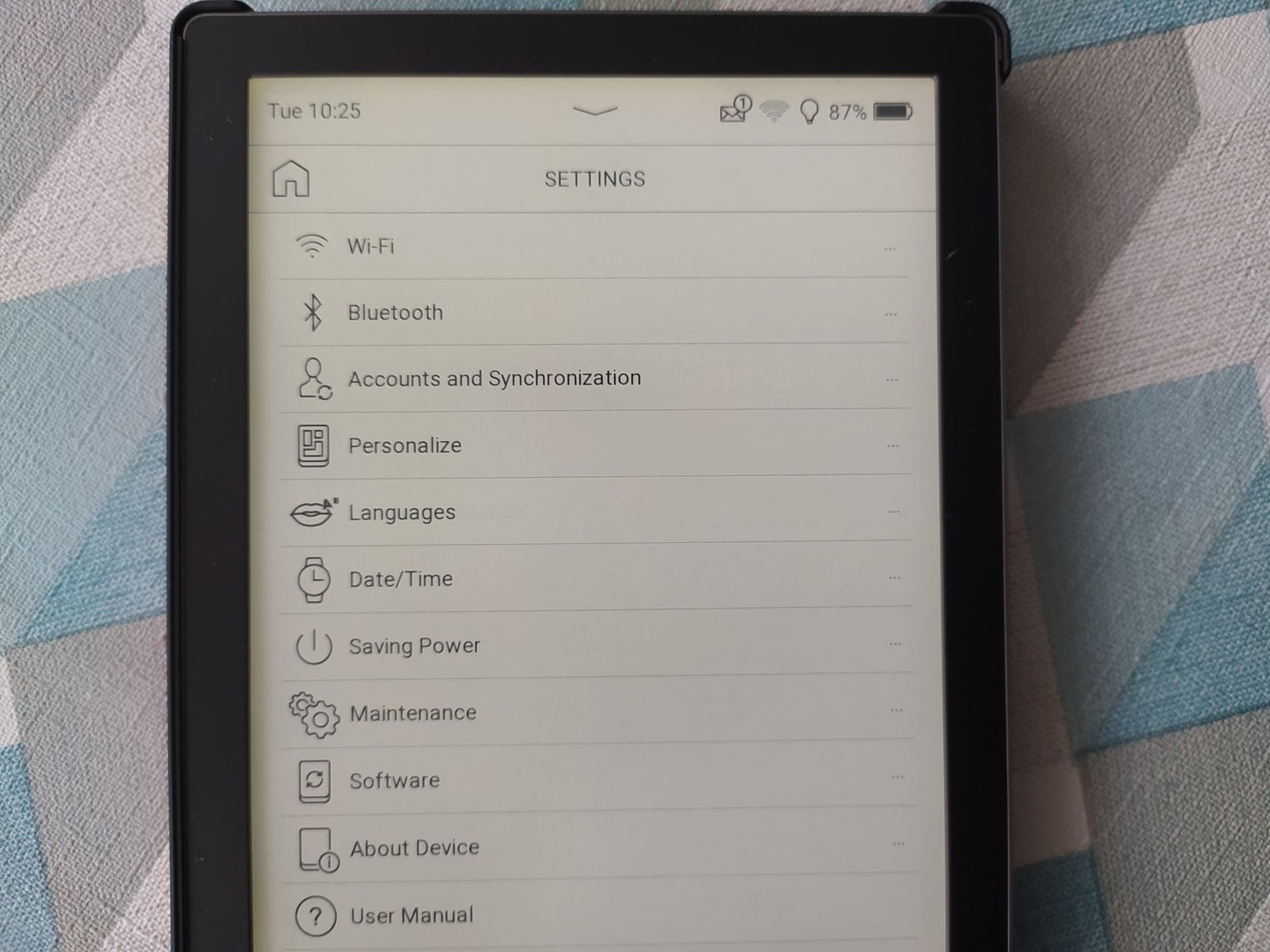
So, to adjust the touch screen, you first need to go to Settings and display this screen:
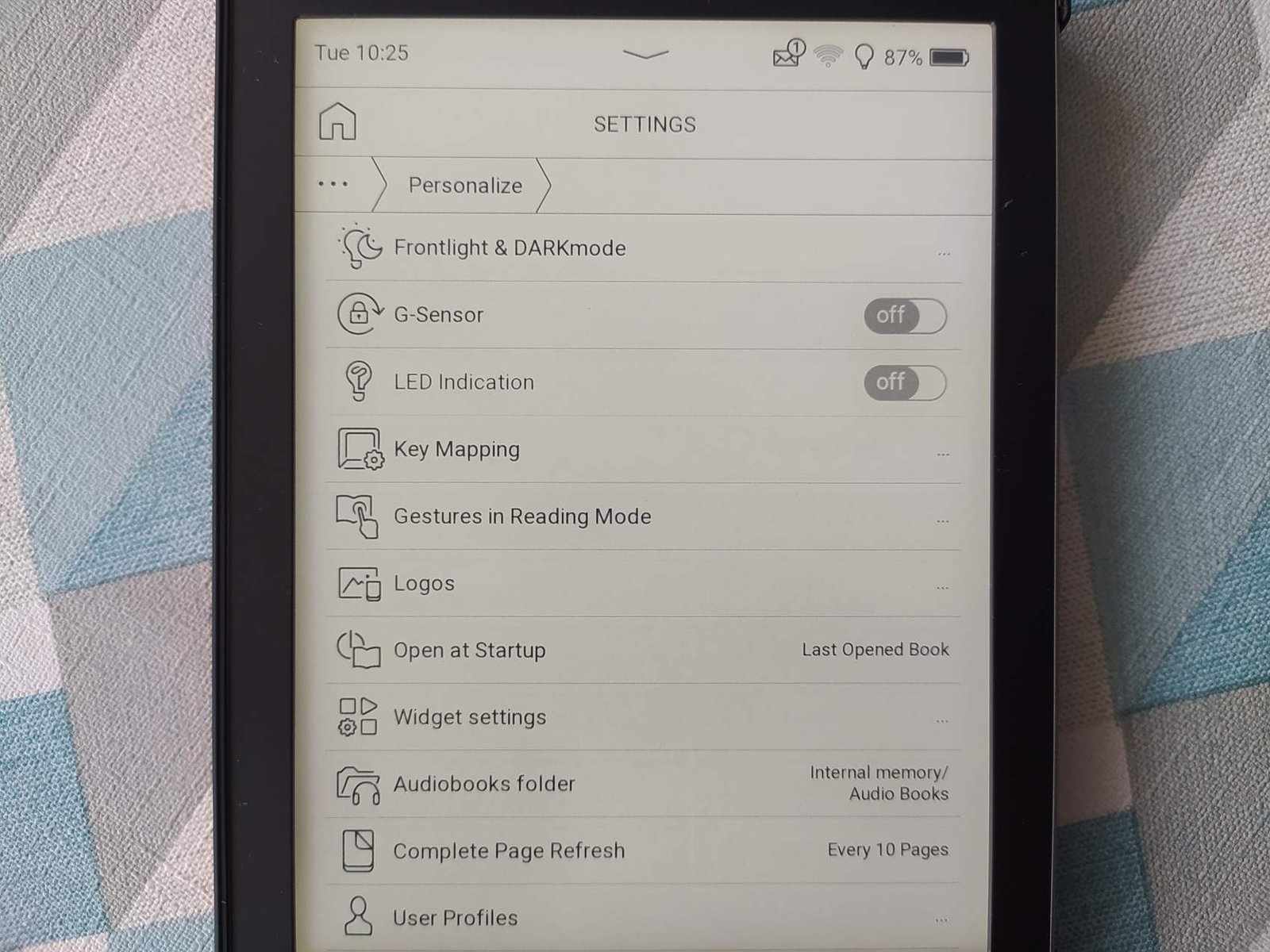
Then press Personalize to display this new screen:
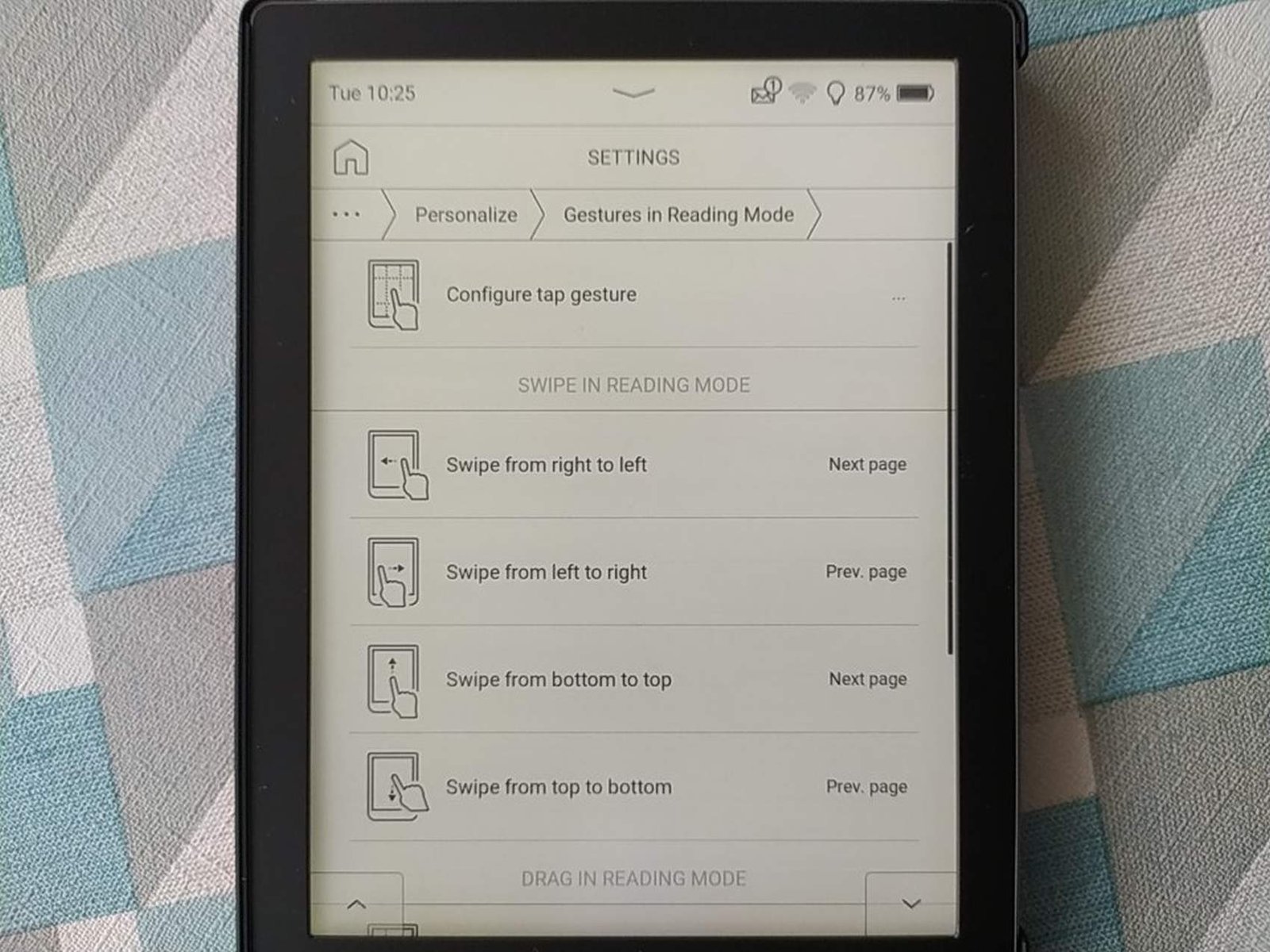
Select Gestures in Reading mode:
This is where you can assign actions for all the Pocketbook eReader’s touch capabilities in reading mode (i.e. when you’re reading an ebook).
You can change the swiping behavior.
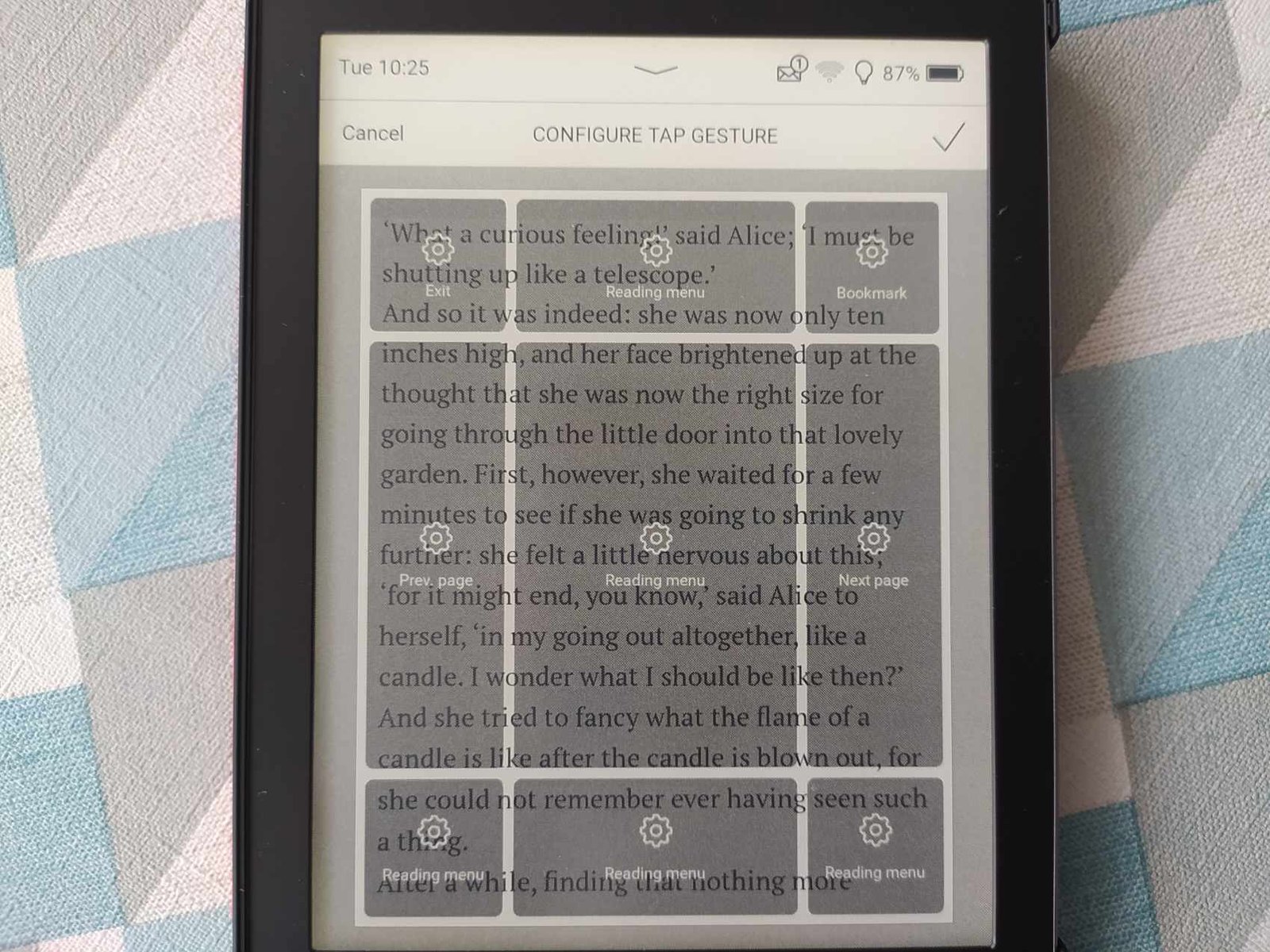
But even more interestingly, you can change all gestures on different parts of the screen by selecting Configure Tap Gestures:
Each area of the screen can then be configured to suit your needs.
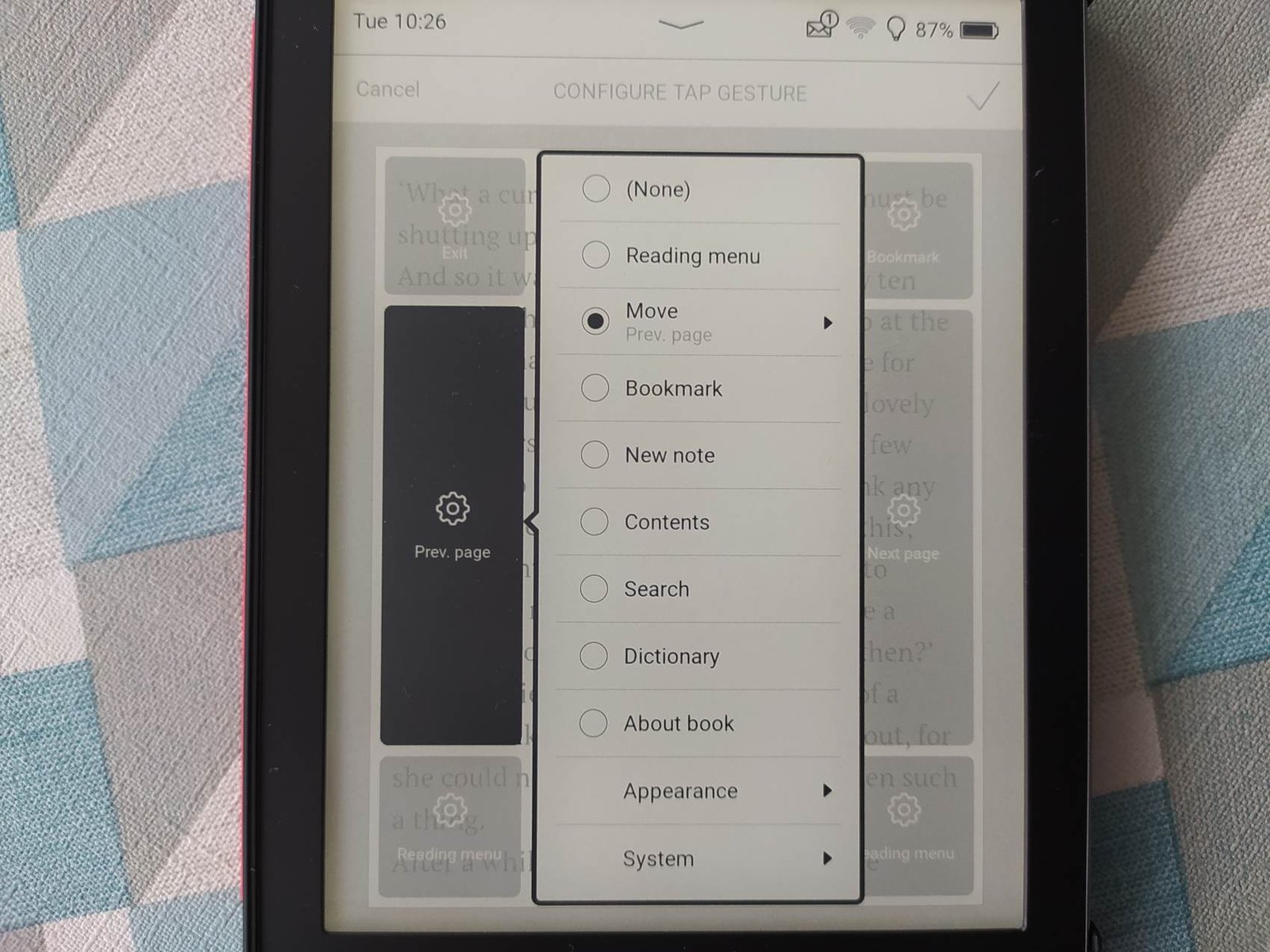
To change the behavior of any area of the screen, simply press on it and select the option that suits you best:
You can then totally modify the behavior of the e-reader’s touch functions!
A word of warning: even if your e-reader has physical buttons and you want to deactivate the touchscreen, I recommend that you leave a touch zone active so that you can quickly access the home screen.
You don’t need a e-reader to read books – all you need is a smartphone. But with a bigger screen, it’s a little better! Here are the best apps for reading on a tablet.
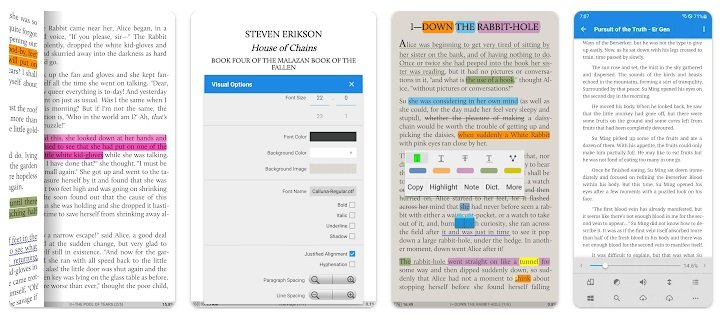
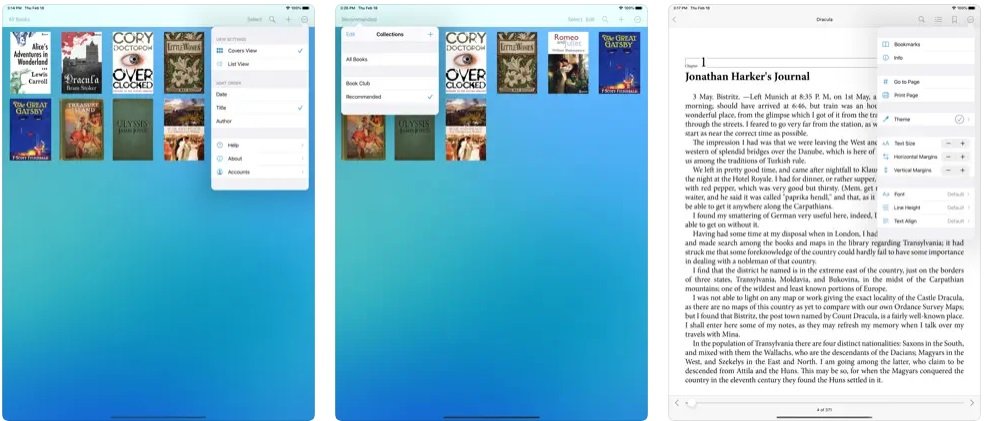
Which app for reading books on a tablet? The best apps for reading books on a tablet are: Aldiko, Moon Reader, Amazon Kindle, Kobo Books, Lisa, Bluefire Reader, KoReader and FBReader.
Let’s take a closer look at each of these applications.
Aldiko Next
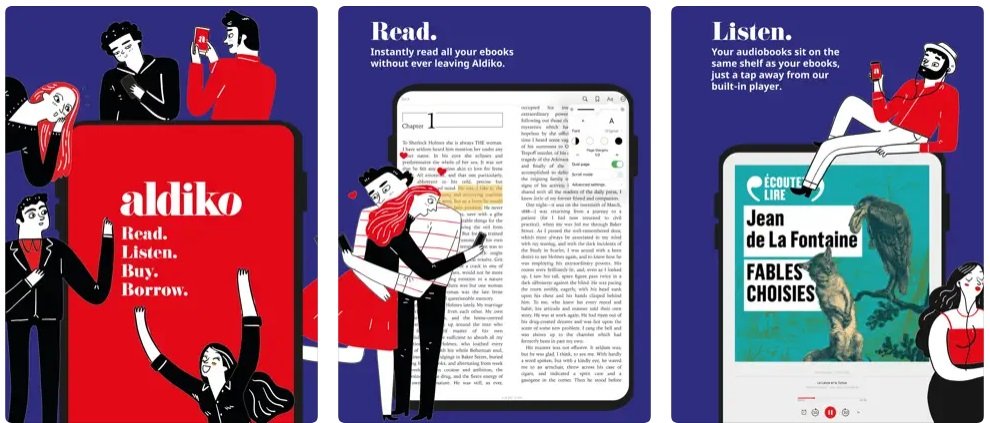
For me, Aldiko (or Aldiko Next) is the best application for reading on a tablet.
It offers a wide range of settings, and you can download free books directly from the public domain.
What’s more, it’s fully compatible with EPUB and PDF formats (with and without Adobe DRM protection).
With Aldiko, you can customize the way text is displayed (typeface, size, font, margins, etc.), which makes it really handy even on small screens.
With some 20 million users, Aldiko is also without doubt the most popular application for reading ebooks on tablets. It’s the application I use on my smartphone.
Aldiko is free, but a paid version offers extra features such as the ability to annotate books or highlight certain passages. Aldiko on Android. Aldiko on iOS (iPad).
Another classic, the Moon Reader application offers comprehensive functionality, with excellent support for a wide range of ebook formats: epub, pdf, mobi, chm, cbr, cbz, umd, fb2, txt, html, rar, zip.
The quality is top-notch, and the Moon Reader app also has the most comprehensive settings for those who like to read in the dark: fine-light management, blue-light filter and tint, night mode, and more.
There are, of course, the usual functions for managing characters, fonts, line spacing and so on.
The application is only available for Android tablets, and can be downloaded free of charge. There is also a paid version which removes advertising and adds other functions, including text-to-speech.
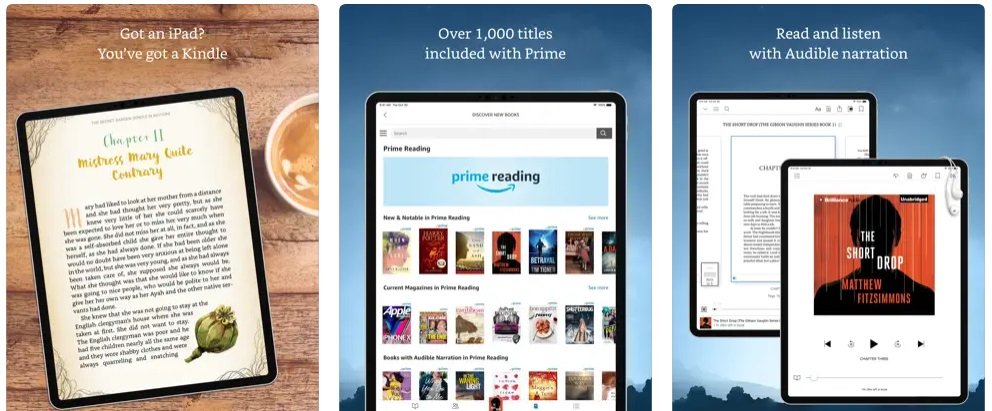
If you want to read a book that’s only available on Kindle, you have a number of options: read on your computer, buy a e-reader or use a Kindle book-reading app on your smartphone or tablet.
The Amazon Kindle app is available free of charge on Android and iOS, and does exactly what it’s supposed to do: read Kindle books.
It’s fast and allows you to do almost everything a reading device can do in terms of text configuration: font, text size, margins, line spacing, etc.
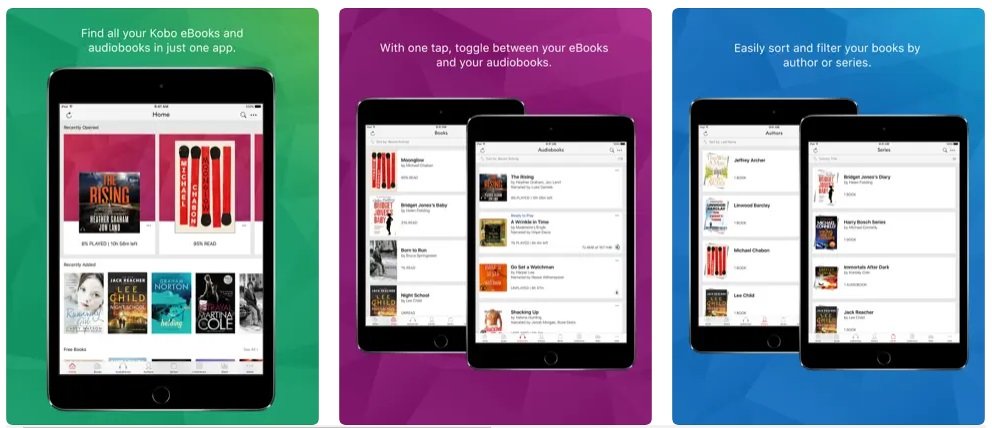
Just like Kindle, the Kobo Books application is available to enable you to read your ebooks purchased on the Kobo platform if you don’t have a reading device at hand.
You’ll find everything you need to read the ebooks in your possession without a hitch.
The app is free and available for Android tablets and iPads.
The app has recently been enhanced with a potentially interesting additional feature: you can buy and read audiobooks with the Kobo Books app.
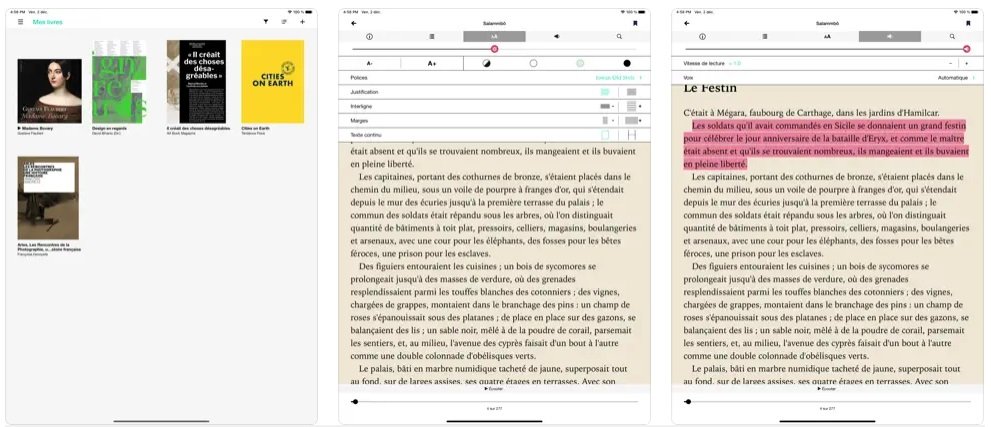
Lisa is a very recent application for reading digital books, which has one advantage: it’s compatible with Readium LCP DRM.
Otherwise, it’s an application with a rather strange ergonomics that won’t suit everyone, but it has a very nice appearance.
It is compatible with the following file formats: PDF, EPUB2, EPUB3. Lisa can also be used to read comics or ebooks containing multimedia content (sound, images or video).
Lisa is available free of charge for iOs and Android.
This selection is coming to an end, and if you still haven’t found the tablet book-reading app that’s right for you, you can try Bluefire Reader.
Available for free download on iPad and Android tablet, this application is based on a simple proposition: allow you to read digital books protected with Adobe DRM (EPUB and PDF formats).
Beyond that, the application is fairly generic, offering nothing that really sets it apart from the competition.
In fact, it’s less comprehensive than Moon Reader or Aldiko, but it also has the advantage of being very easy to use.
This selection is obviously not exhaustive, and here are a few Android and/or iPhone smartphone applications worth mentioning:
KoReader: this is a rather special program, designed for hobbyists, since it can even be installed on certain e-readers (official website). It offers many customization options.
FBReader: a full-featured program for Android, iPhone and PC that supports a wide range of file formats.
I also invite you to take a look at our e-reader buyer’s guide if you want to take your digital reading more seriously, with a device specially designed for the purpose.
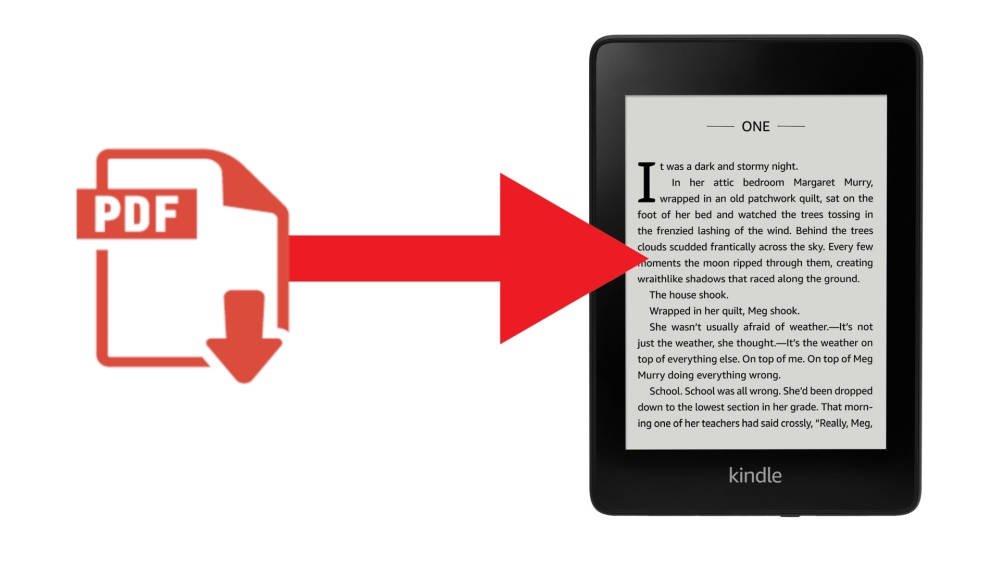
In this short tutorial, you’ll see how easy it is to read a PDF file on your Kindle, Kindle Paperwhite, Kindle Scribe, Kindle Voyage or Kindle Oasis e-reader.
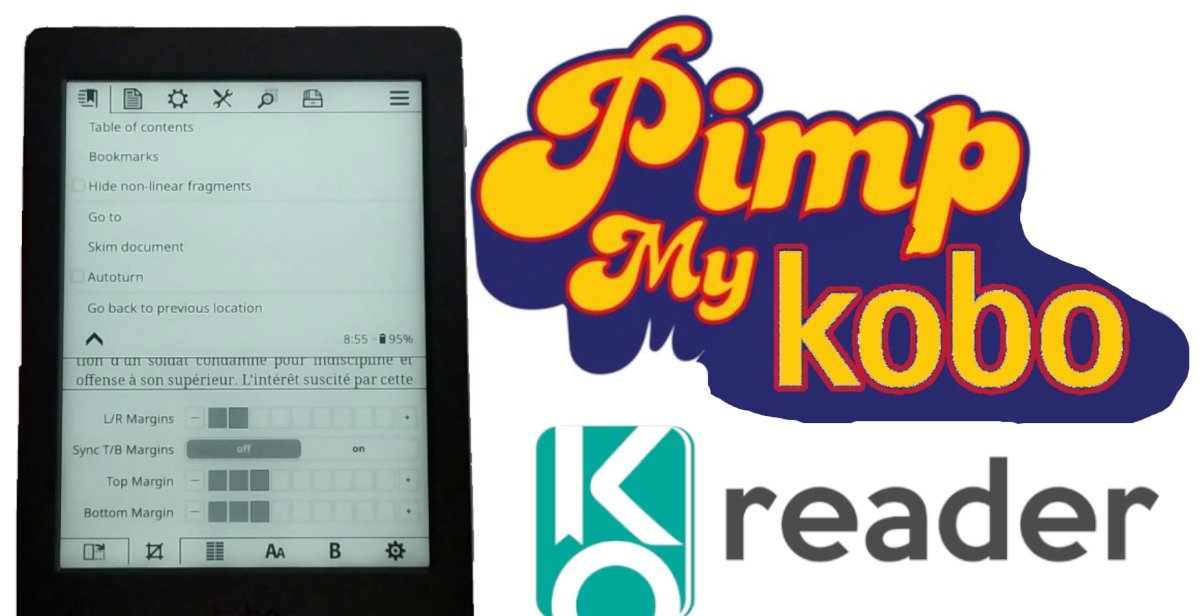
KOReader is a free software package that installs on your e-reader to provide additional functionality. In this article, we’ll look at how to install KOReader on a Kobo e-reader.
The only two things you need to know about KOReader on Kobo are the following:
Installing KOReader on Kobo is free of charge and should not harm your e-reader.
Installing KOReader on your Kobo e-reader changes the way it works: if you need to invoke your e-reader’s warranty, this could be a problem.
If anything happens to your e-reader, it’s your fault. I can’t be held responsible for any problems that may arise.
Warning before installation
According to my information, installing KOReader poses no risk to your Kobo e-reader. In fact, you can continue to use the old Kobo interface if you don’t like KOReader.
⚠️ But I wouldn’t recommend installing KOReader on a recent e-reader or one still under warranty.
KOReader is very interesting software, but if you’re happy with your Kobo e-reader, there’s no reason to install new reading software on it.
If, on the other hand, you have a Kobo e-reader in a drawer, then this software could well give your e-reader a facelift, and you should consider installing it.
Installing KOReader on a Kobo e-reader
For the purposes of this tutorial, I installed KOReader on a Kobo Nia e-reader.
You need to download the latest version of the KOReader bundle, which you can find here: Preparing for installation
You need to connect your Kobo e-reader to your Windows 10 PC with the USB cable and enable file sharing on your e-reader’s screen.
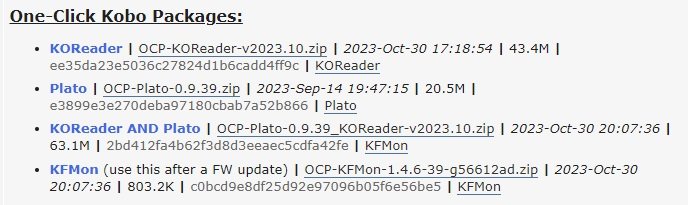
You need to download the latest version of the KOReader bundle (a .zip file), which you can find here: https://www.mobileread.com/forums/showthread.php?t=314220 (at the end of the first message) (at the end of the first message)
If you want, you can install Plato reader for your Kobo ereader.
Plug your Kobo eReader to your computer over USB
You need to connect your Kobo e-reader to your Windows 10 PC (or Windows 11) with the USB cable and enable file sharing on your e-reader’s screen.
Copy this script in the same folder of your Kobo (where the ZIP file is located).
Now right-click on the "install.ps1" file and click on "Run with Powershell".
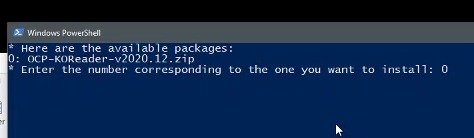
A window will open asking for the KOReader version to be installed (the "package").
Normally, the installation program should find only one file, so enter "0" ("zero") and press the "enter" key on your keyboard:
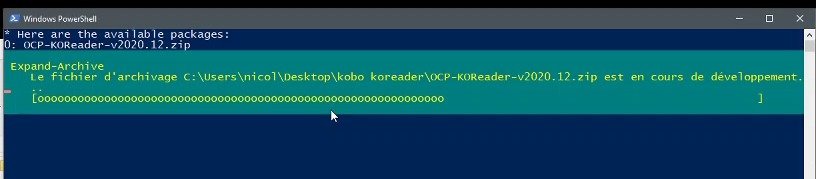
A new message with a progress bar will appear, showing the progress of the installation.
⚠️ Wait a few minutes and do not disconnect your Kobo e-reader.
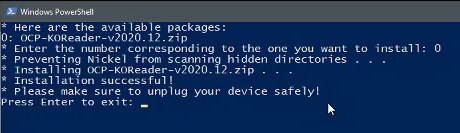
A new message appears, indicating that you need to eject your e-reader.
Restarting the Kobo e-reader
Once the installation is complete, your e-reader should restart itself.
**If it doesn’t, that means there is a problem. You can restart it and try to install KOReader again.
After a short wait, you’ll be back on your e-reader’s usual screen.
Enjoy KOReader on your Kobo
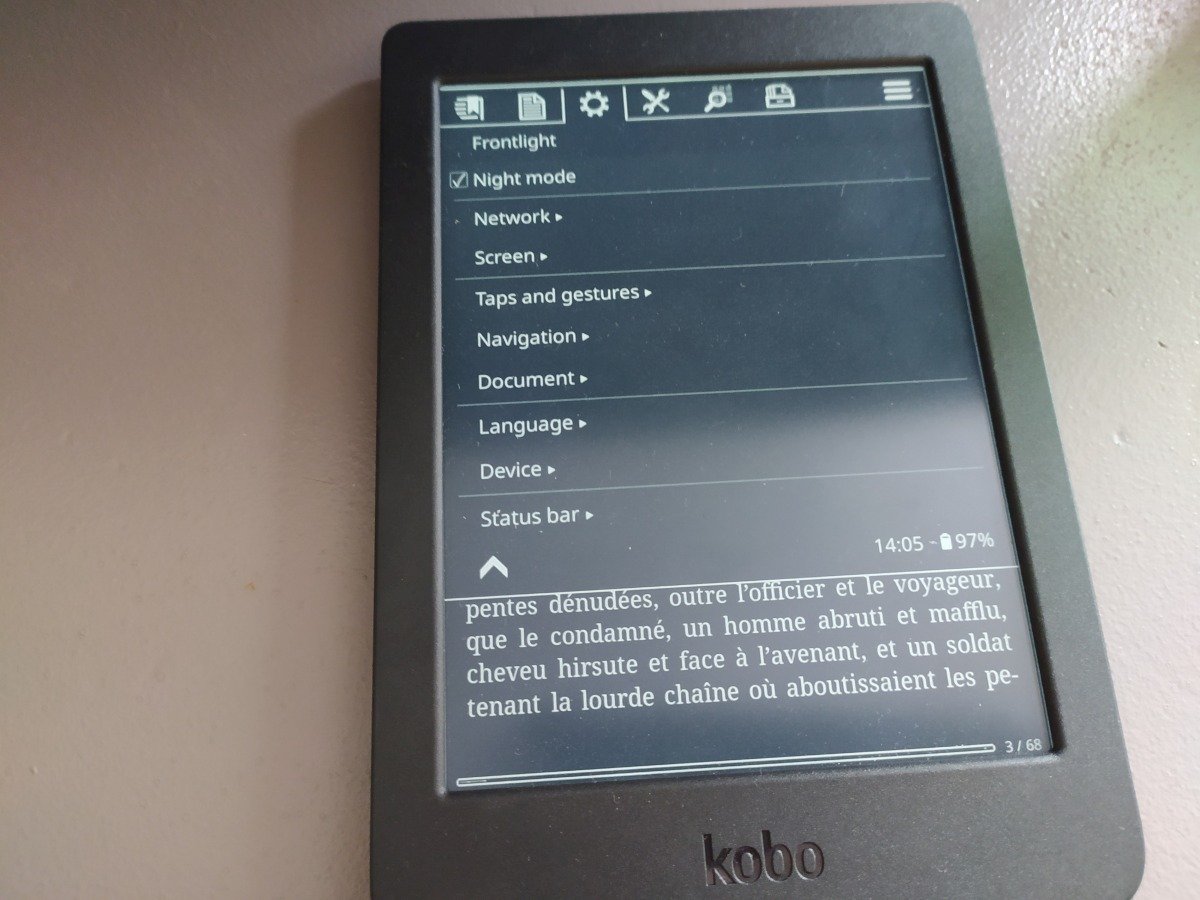
KOReader is now installed and all you have to do is launch this new reading software using the new button that has appeared in the bottom right-hand corner of your Kobo e-reader.
Conclusion
As we’ve just seen, installation is fairly straightforward, taking just a few minutes at most.
Bear in mind, however, that this software is primarily designed for people who are comfortable with computers.
However, I think its existence is very interesting, as it offers numerous possibilities for customizing your Kobo ereader.
If you’ve had your e-reader for a while and don’t use it anymore, this software can give it a facelift.
It changes a lot of things on your e-reader, and the new interface takes some getting used to. For example, I’ve seen it improve the speed of the interface on my Kobo Nia e-reader.
As the year starts, it’s time to focus on what’s in store for 2024 in terms of e-readers, with new models expected soon.
Two new Kobo e-readers
It’s no secret that Kobo will soon be offering a new e-reader.
From what little information has leaked out, it’s likely to be two e- readers to replace the Kobo Sage and the Kobo Libra 2.
But the Kobo Nia is an aging e-reader (released 3 years ago) that will need updating to compete with the much better Kindle and the new Pocketbook Verse.
Color e-readers were the talk of the town in 2023, and we can expect new releases in 2024.
On the one hand, new e-ink color displays have only just arrived on the market. These include the Pocketbook Viva (with its Gallery 3 screen) and the very recent Pocketbook InkPad Color 3 with its latest-generation Kaleido 3 screen.
On the other hand, several color e-readers announced for 2023 have had very limited releases, and we can expect some of these models to be available again in 2024 (I’m thinking of e-readers from the Onyx and iReader brands, for example).
As usual, innovation will undoubtedly come from Asian brands, who won’t hesitate to offer new e-readers with the latest-generation color screens.
A new Kindle?
It seems appropriate for Kindle to release one or more new e-readers in 2024.
The Kindle Oasis is quite old, and it would be interesting to propose a new version with a better screen and, why not, a color screen. However, I think it unlikely that this will happen (a color screen for a Kindle) for cost reasons.
Another possibility: a new Kindle Paperwhite with a newer screen or more storage is also on the cards, although this hypothesis seems less likely to me.
Productivity machine: a growing trend
Like every year, we can expect to see the arrival of *new ebook reading machines for the workplace with productivity tools.
As with the Kindle Scribe, the ReMarkable 2 or Kobo Elipsa 2E, these machines feature large 10-inch screens (sometimes up to 13.3 inches), a stylus and the tools to work with them.
These machines use an e ink screen and sometimes an Android system that enables the installation of third-party reading or productivity applications.
The year 2024 should once again bring us interesting new models in this product range.
New Pocketbook e-readers
Like every year, Pocketbook is going to offer us new e-readers.
These will undoubtedly be models with color screens or top-of-the-range models. It should be noted that the recent Pocketbook Viva is not yet available. It could therefore arrive in early 2024.
Calibre software is well known to owners of a large personal ebook library, as it allows you to manage your digital books and transfer them to your e-reader. Version 7 of Calibre has just been released, with a number of new features.
Calibre is free, open-source software that runs on Windows, Mac OS and Linux computers. To better understand the benefits of this software, I recommend you read this article on getting started with Calibre.
Here are a few new features that may be of interest to you.
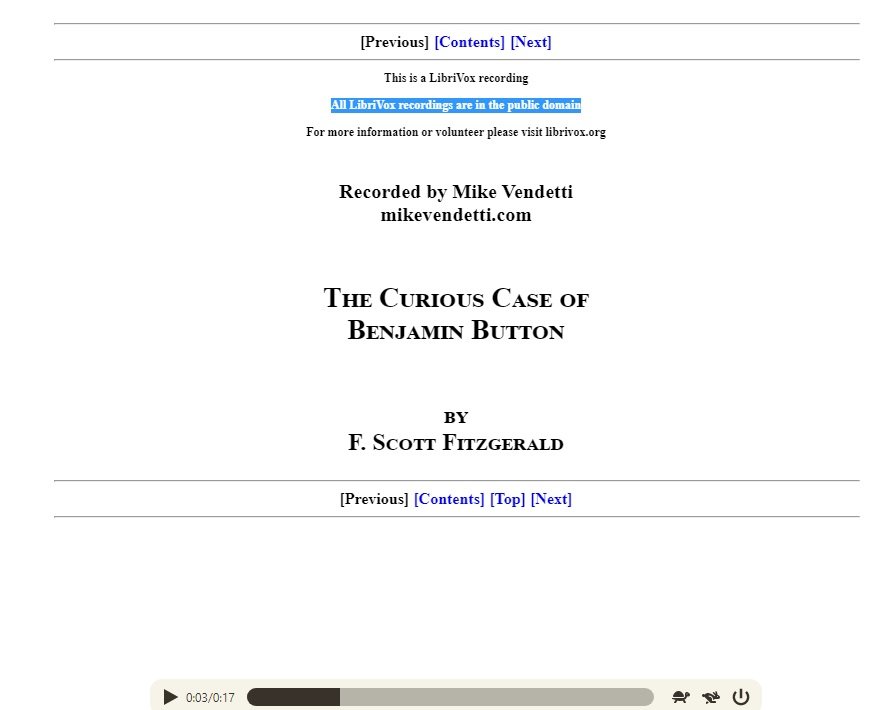
Audiobooks in EPUB format
A little-known feature of the EPUB file format is its ability to store the audio version of an ebook. The idea is to have a single file containing both the text and the audiobook.
Calibre therefore offers audio functionality to EPUB files that support this feature.
According to my tests, this works very well and is pleasant to listen to. Note that there is already a text-to-speech function in Calibre.
Notes for ebook data
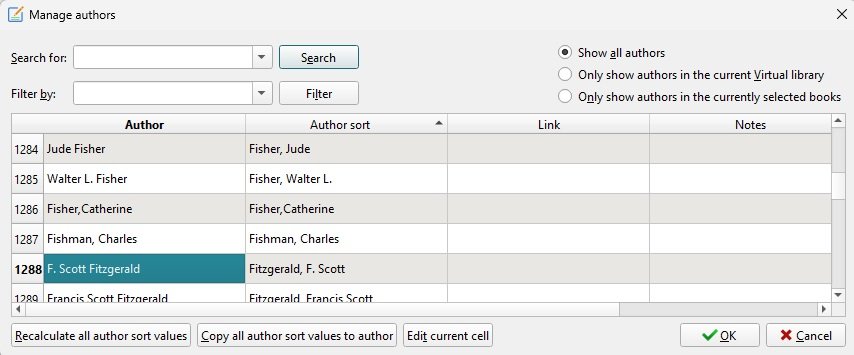
Calibre 7 lets you enter additional information on many data items in the form of "notes".
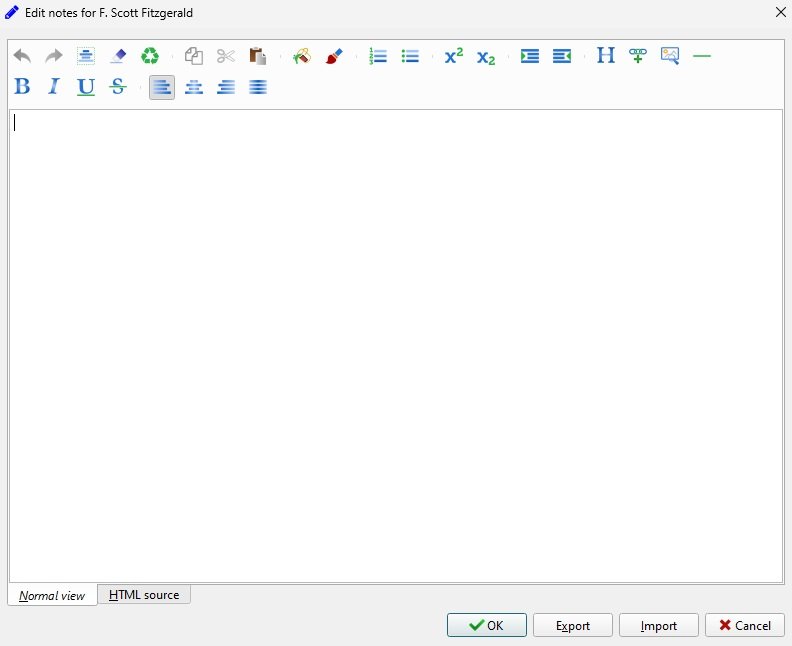
For example, you can add a note to an author’s record:
These notes can contain formatted text, as well as links and images.
More data for ebooks
Another interesting feature for users wishing to store additional information on ebooks: it is now possible to add "metadata" files to digital books in the library.
To do this, select a book, then click on the little arrow in the "Add book" button and select "Add data files to selected book records".
A recycle garbage can for going back
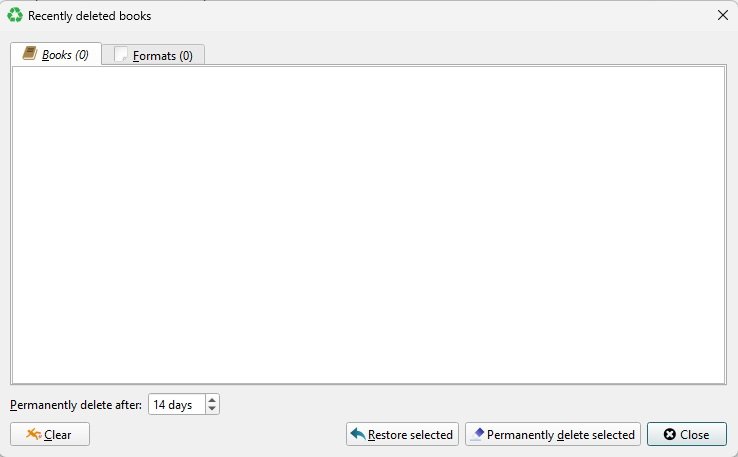
Calibre 7 comes with its own recycle garbage can, allowing you to retrieve books that you may have deleted by mistake.
It is now possible to undo any such mistake.
Other updates in Calibre 7
As with every major release of Calibre, a number of small improvements have been made to the software, including :
Improved support for HTML images in the ebook reader
Bug fixes
Updated content server for sharing your library over a local network
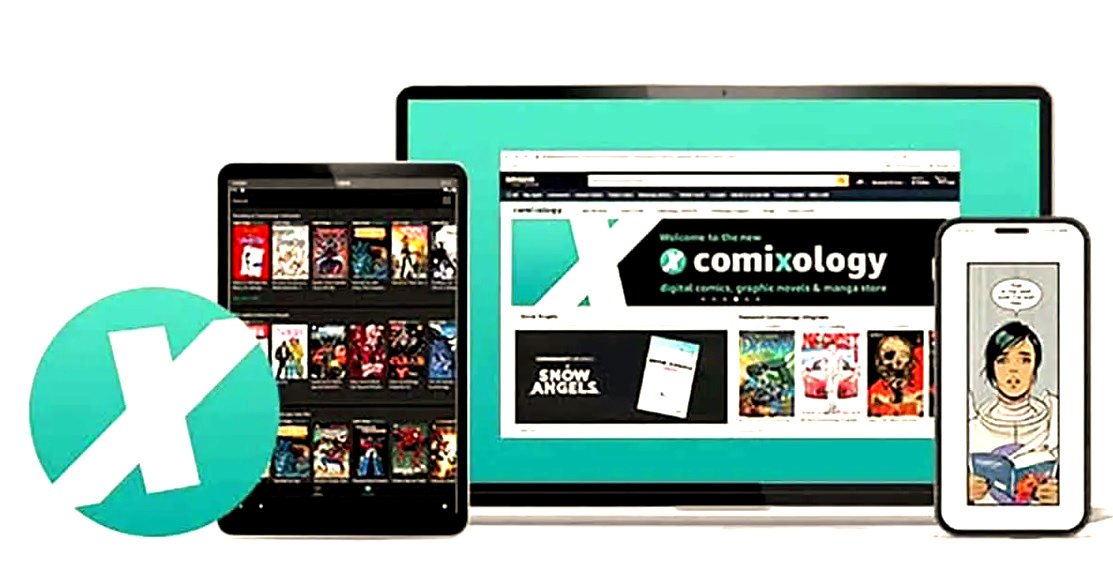
Comixology was acquired in 2014, and since then Amazon has tried various solutions to keep this digital comics reading service alive. In the end, Comixology will close and be fully integrated into Amazon.
What is Comixology?
Available via an app for smartphones and tablets, as well as from the service’s website, Comixology offers a wide selection of comics – mainly in English.
Backed by partnerships with a number of major publishers (Image Comics, Dark Horse, Valiant Comics, Archie Comics, etc.), the platform offers hundreds of thousands of titles in its streaming catalog.
The end of Comixology
Amazon has been trying to fully integrate Comixology’s offering into its Amazon Kindle bookshop since 2021. But, after several unsuccessful attempts, this solution did not seem to have been chosen.
However, Amazon has just announced that Comixology applications will no longer work from December 4, 2023.
The entire catalog will be transferred to the Amazon Kindle bookstore. For readers who have comics in their account, these volumes will be automatically transferred to their Kindle library and thus accessible both on the site and on Kindle e-readers.
For smartphone and tablet users, they will now need to use the Kindle app available on Android and iOS. It will be necessary to use the same login details on the Kindle app as those used on the old Comixology app. (see details here)
Amazon Fire tablet users will also benefit from this change, as everything will be accessible in the Kindle section.
This does not come without a drawback, as it will be necessary to download the comics again on the Kindle application.
To simplify navigation, it is possible to filter titles and books owned in your library using the "Comics & Manga" filter in the app.
With this merger, you should now have more choice in the titles available with the Kindle subscription and Prime Reading (for Amazon Prime subscribers). Of course, you’ll have to judge for yourself.
What strategy for Amazon?
Amazon is looking to unite users of its digital reading services by offering more choice to comic book and ebook readers.
Everyone will be able to access the entire catalog, and this should give readers more choice.
But it’s also a way of standing out from other reading services. The aim is to attract more people to the Kindle ecosystem, to the detriment of competing offers from Kobo (with Kobo Plus).
We’ll see in the coming months whether this decision is the right one, and whether current Comixology users will migrate to the Kindle application without any problems…
For the moment we don’t know what will happen to Comixology’s employees and whether they will join Amazon’s teams.
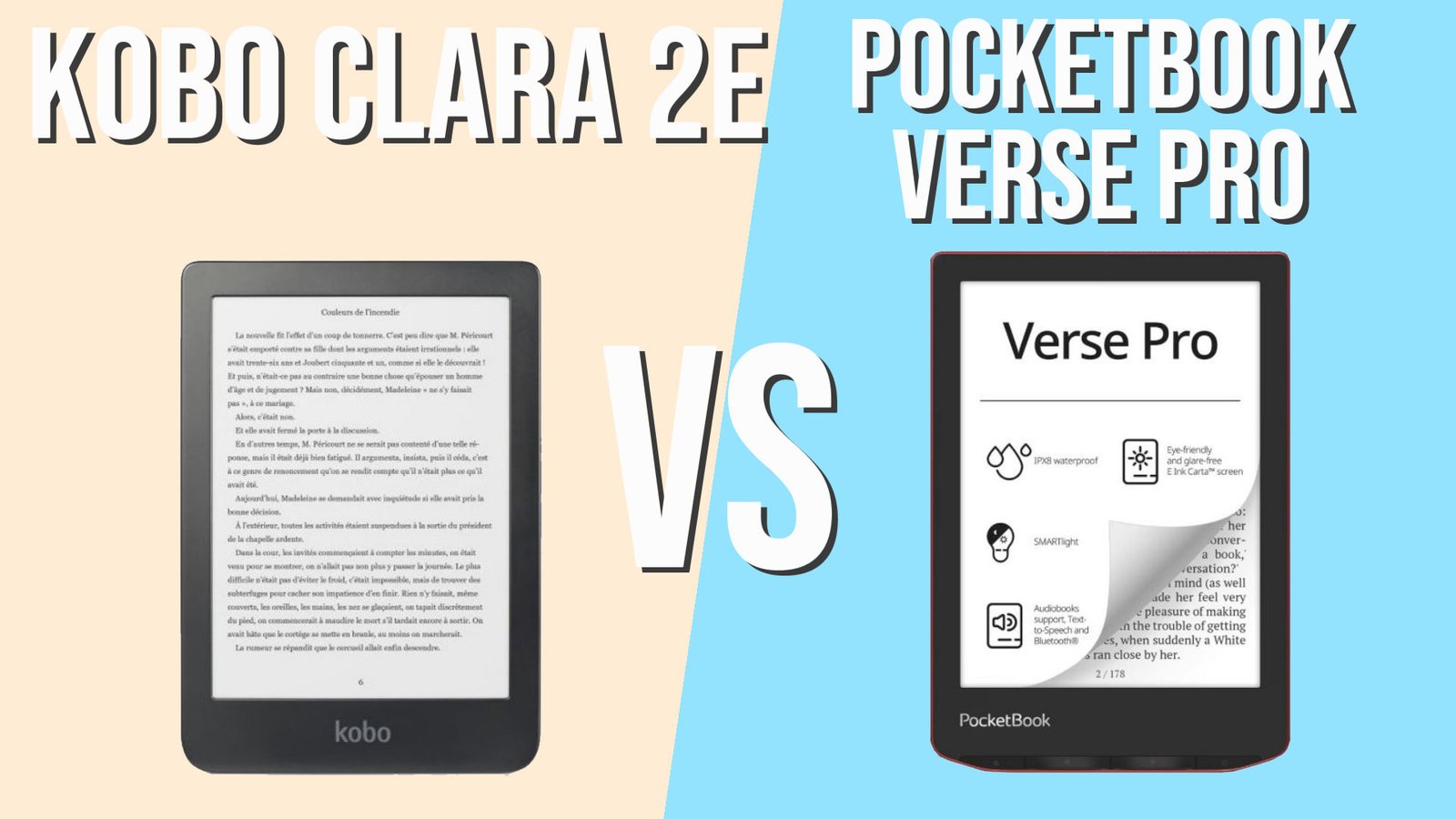
If you’re looking for an excellent all-round e-reader, you can now choose between two great e-readers: the Kobo Clara 2E and the Pocketbook Verse Pro. In this comparison, we’ll see which is the best e-reader.
The Pocketbook Verse Pro is the new top-of-the-range 6-inch e-reader from the brand Pocketbook. This full review will enable you to take a close look at all the features and functionalities of this Pocketbook Verse Pro.